Every Spin-Off #2 · Honeywell Aerospace: The $16 Million Blocking $18 Billion
Every Spin-Off #2: The market is pricing a supply problem as if it were a demand problem.

Honeywell Aerospace held its frst investor day on 3 June 2026 and told everyone what the year would look like. Organic sales up 7 to 9 per cent. Pro forma standalone adjusted EBIT of $4.65bn to $4.75bn.
Twenty-six days later, on 29 June, the company was handed to Honeywell shareholders at one HONA share for every two HON, around 317 million shares, no vote needed.
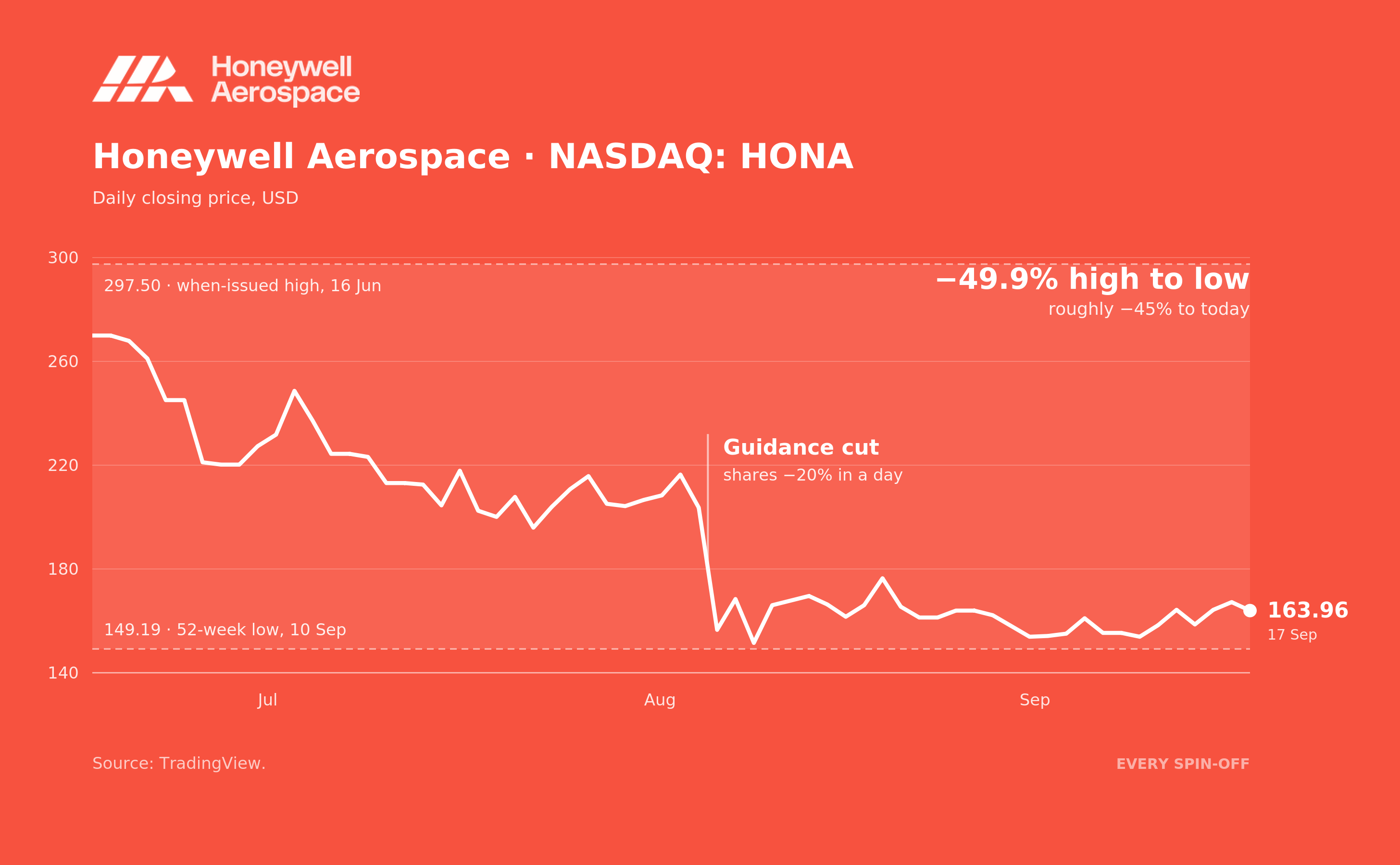
Five weeks after that it cut. Organic growth down to 4 to 5 per cent, adjusted EBIT down to $4.35bn to $4.45bn, and a first EPS range of $7.60 to $7.90 against a street that had been sitting above $10. The shares fell about 20 per cent that day. They are now roughly 45 per cent below the $297.50 they touched when-issued on 16 June, and they printed a 52-week low of $149.19 on 10 September before recovering to where they sit today.
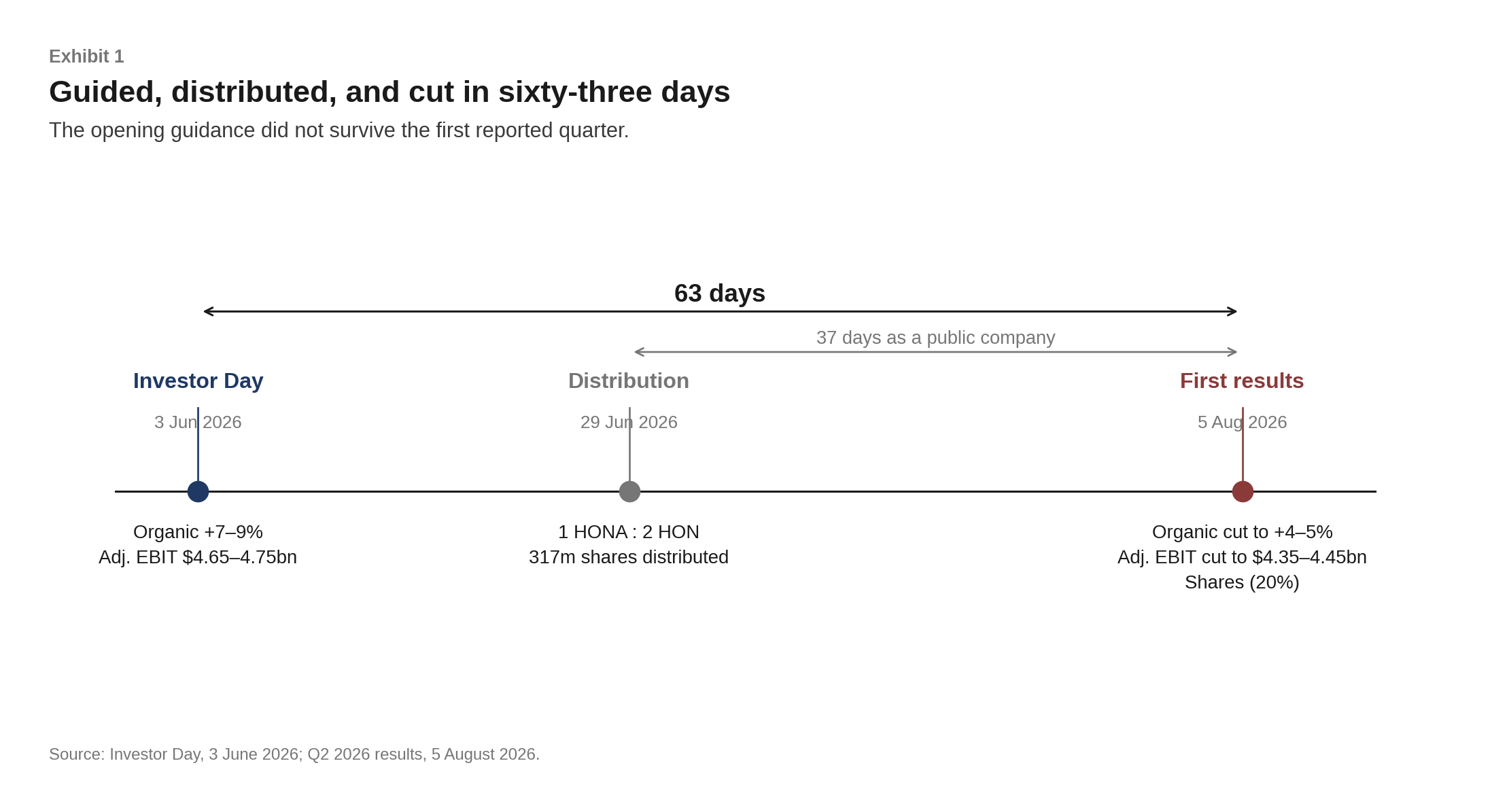
Opening guidance from a spin-off is usually the safest forecast a company ever gives. Management has run the business inside the parent for years, they know the order book better than anyone, and the only thing they need on day one is a debut that holds up. Most of these numbers are set low enough to beat. This one lasted nine weeks. My gym membership has a longer cooling-off period.
I want to be careful about what that proves, because I don’t think it proves bad faith and I’ll make the case for that later. But it is the reason the market now refuses to underwrite anything management says about 2030, and everything below runs through it.
1. What you are buying
HONA sells content that goes onto an aircraft and then stays there for thirty or forty years. About 47,000 auxiliary power units in service, more than 20,000 engines, content on something like 90 per cent of the flying fleet, spread across 250-plus platforms still in production with no single one above 8 per cent of sales. Once a part is certified onto an airframe nobody re-certifies a substitute, because the paperwork costs more than the part.
That is the whole moat, and it is a good one. Aviation is the only industry where “we’ve always done it this way” is a safety feature.
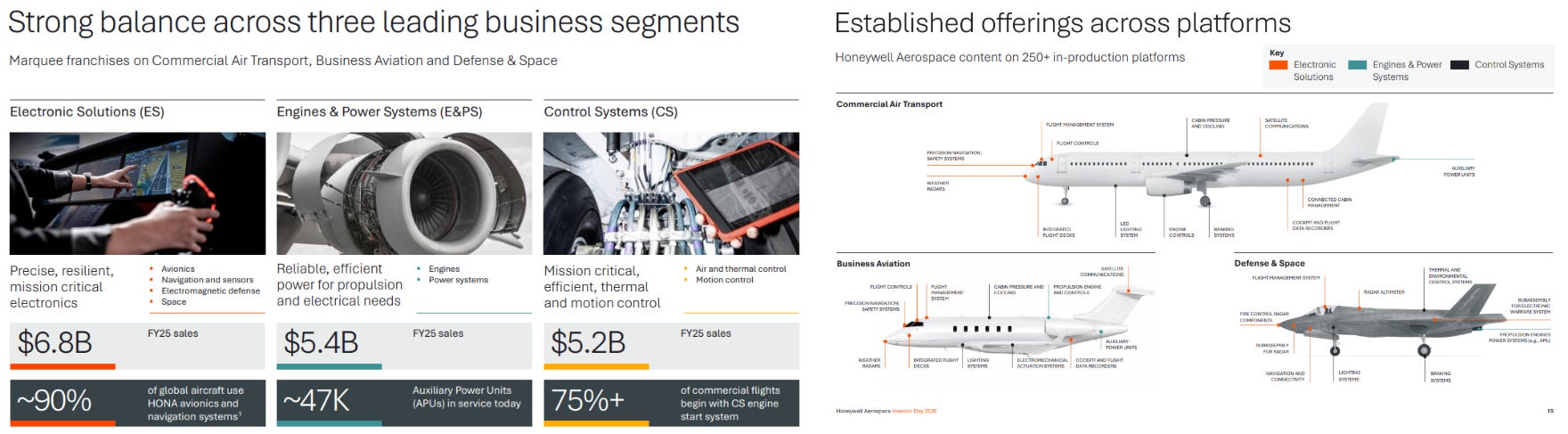
So you have an annuity, wrapped around an original-equipment business that sells the annuity cheaply in order to create it. Commercial aftermarket is roughly 44 per cent of sales and earns a lot more than OE. How much more, the company won't say, and the fact that they won't say it turns out to matter enormously, for reasons that only become obvious around section 14.
Buried in there is the best line in the whole file. Recurring managed uplift,, selling new capability into aircraft that are already flying, runs at $1.6bn to $1.8bn, has compounded at around 18 per cent since 2021, and doesn’t move with flight hours. That’s roughly a tenth of the company growing three times faster than the rest of it, increasingly delivered as software. It gets a slide and a half at the investor day. The supply chain, which is currently on fire, gets thirty.
2. The bottleneck
Someone on the 5 August call asked Jim Currier how concentrated the supply problem actually is. He gave a number:
“Critical and constrained suppliers represent roughly 2% of our supply base… 98% of them are performing exceptionally well. Take one supplier — fifteen million, sixteen million dollars past due — that unlocks hundreds of millions of dollars of revenue output.”
Two per cent of about 3,000 direct suppliers is sixty companies. And a supplier sixteen million dollars behind on deliveries is blocking hundreds of millions of revenue, which is a ten-to-twenty times multiplier from the missing part to the cash flow it holds up.
Somewhere in the American Midwest there is a machine shop owner with a backlog problem, a forklift, and absolutely no idea that he is currently the most important man in aerospace.
Josh Jepsen, the CFO, said where the money is going: 70 per cent of the extra tooling investment in the second half goes to constrained castings, the rest to forgings, complex machining and specialty bearings. Multi-sourcing and in-sourcing spend is up about fourfold on last year. When a company quadruples spending on something in a single half, it has stopped negotiating and started begging.
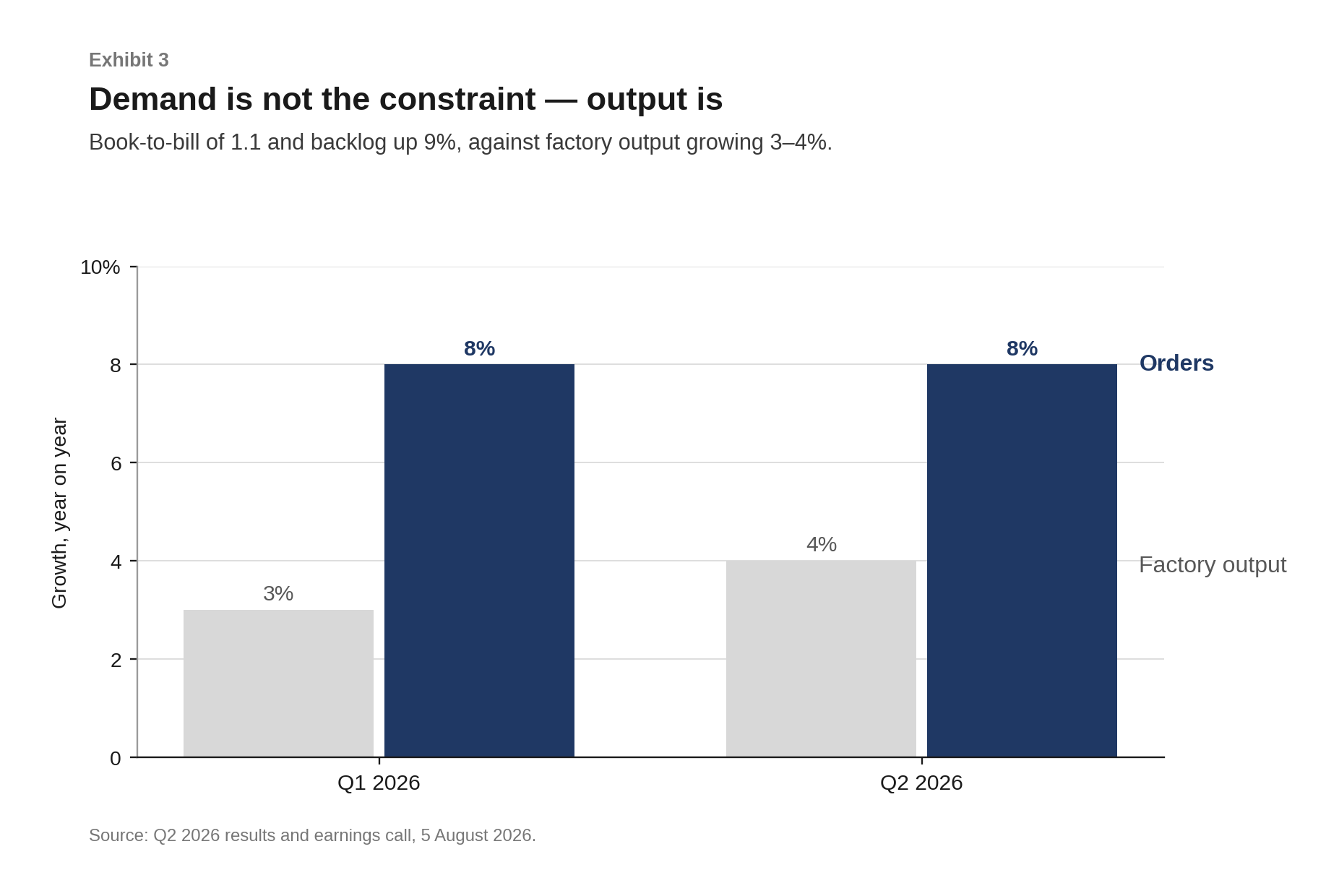
Nothing about demand looks broken. Orders rose 8 per cent with a book-to-bill of 1.1, backlog is $18.15bn and up 9 per cent, and factory output grew 3 per cent in the first quarter and 4 per cent in the second against organic sales of 5 per cent, which tells you they shipped out of inventory and backlog rather than out of production.
Where it hurts is the mix. When parts are short they go first to OE customers with contractual delivery dates and to domestic defence. Everyone else queues, and the people queuing are commercial aftermarket and international defence, both of which earn considerably more. Jepsen said so on the call: the shift from aftermarket to OE and from international defence to domestic is what’s weighing on margin.
You can see it in the numbers. Commercial aftermarket grew 8 per cent in the quarter, and management then guided that same line down to low-to-mid single digits for the year. They are deliberately starving their most profitable revenue because the components are going somewhere else. It is the corporate equivalent of skipping dinner to feed the neighbours, except the neighbours have a contract.
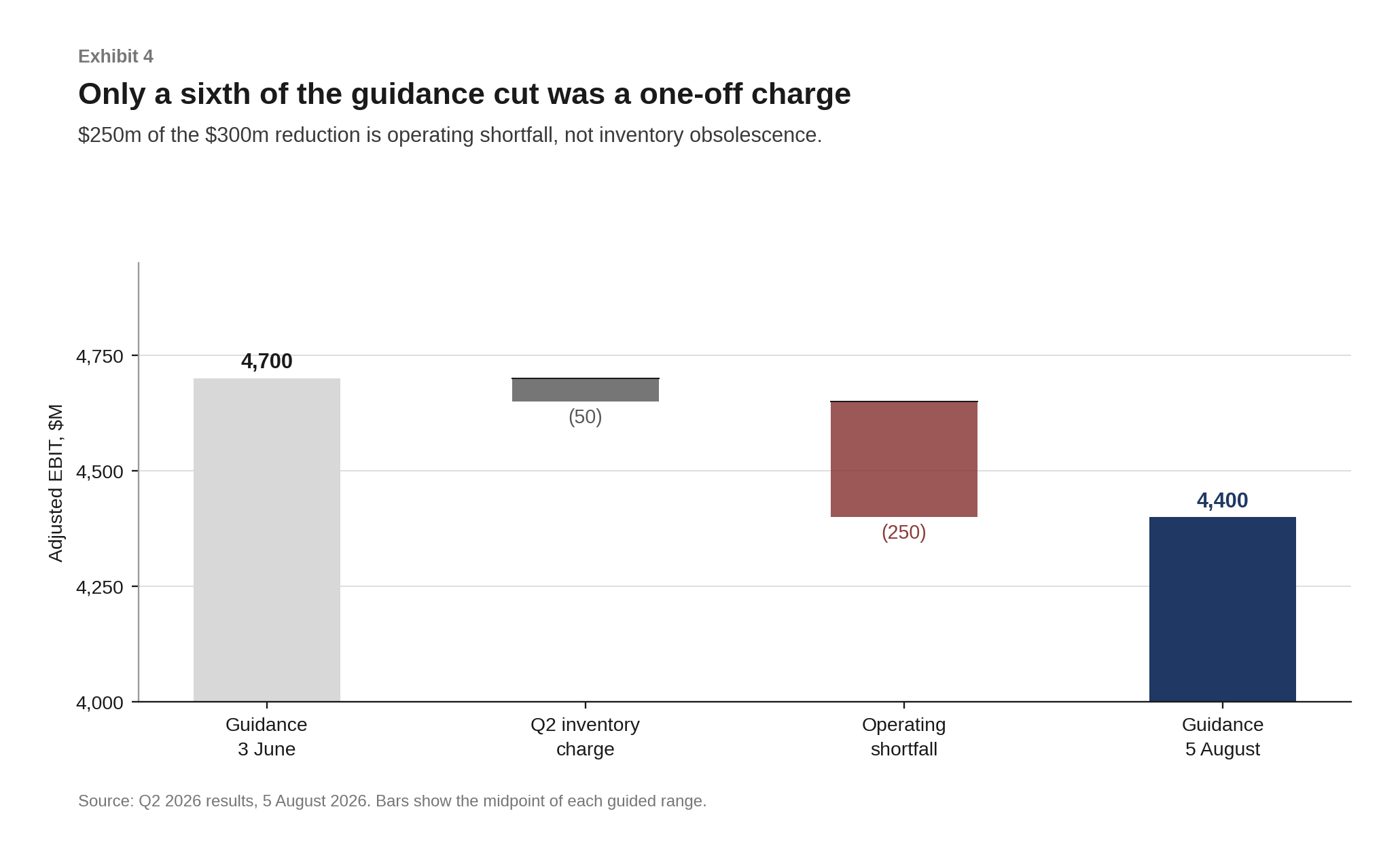
Of the $300m taken out of the EBIT guide, only $50m was the second-quarter inventory charge. The rest is operating.
3. About the Howmet story
There’s an explanation doing the rounds since August that I think is wrong, and correcting it is more useful than repeating it.
The version circulating goes: Precision Castparts had a fire at its biggest plant, everyone including Honeywell piled onto Howmet, Howmet refused to help without long-term commitments, then bought Consolidated Aerospace Manufacturing, the third-biggest player, and doubled prices. It has everything a good markets story needs. A fire, a monopolist, a villain with a pricing strategy.
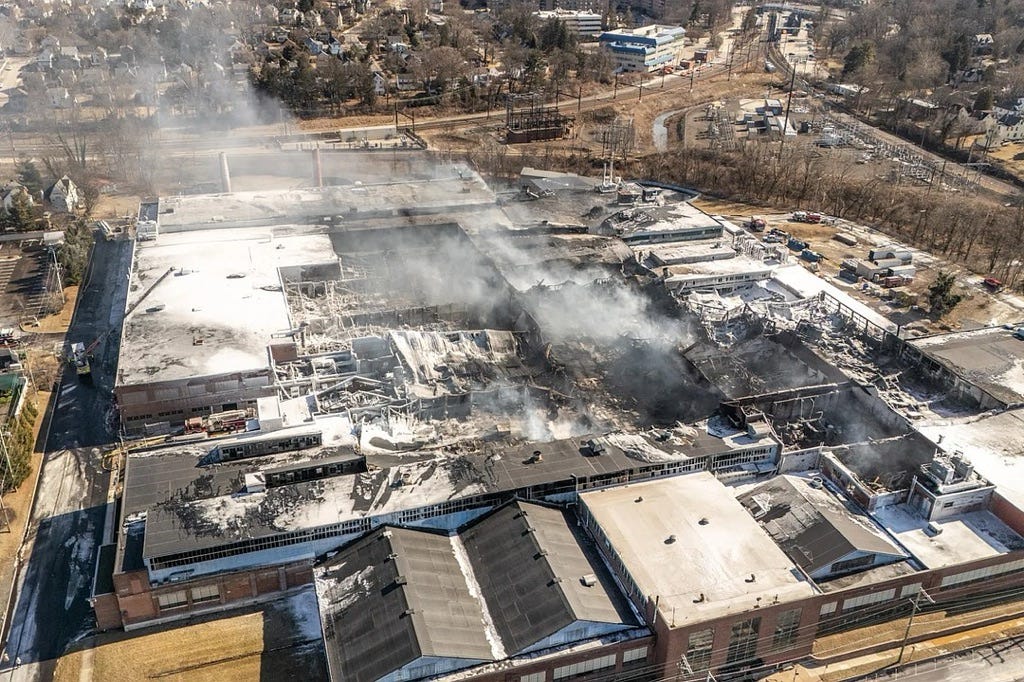
The fire is real. On 17 February 2025 more than 80 per cent of a 560,000 square foot plant burned down at SPS Technologies in Jenkintown, Pennsylvania, a Precision Castparts subsidiary owned by Berkshire. But that plant makes fasteners. Titanium bolts, rivets, hi-locks, high-strength nuts for engines, wings, fuselage and landing gear, used on the 787 and the A350. Precision Castparts moved the work around its other sites.
CAM isn’t a castings business either. Howmet agreed to buy it from Stanley Black & Decker on 22 December 2025 for about $1.8bn and closed on 6 April 2026, and what CAM makes is precision fasteners, fluid fittings, latches, handles, release pins, couplings, clamps, flanges and heat shields. Howmet’s own chief executive described the deal as building out the fastener portfolio. They bought Brunner Manufacturing, another fastener maker, in February.
Which leaves the circulating story explaining a fastener squeeze with a fastener consolidation, and then pinning it on a company whose CFO said on the record that his problem is castings. Everything in it is true except the part where the pieces connect to each other.
I also couldn’t find any source anywhere for Howmet doubling prices, so I’d leave that one alone.
What does hold up is simpler and doesn’t need CAM at all. Castings and forgings are concentrated between two companies, and Howmet says it can produce 90 per cent of all structural and rotating aero-engine components. The other one spent 2025 rebuilding a destroyed factory. Being a buyer in a duopoly where one supplier is distracted and the other is out shopping is an unpleasant place to be, whatever anybody did to prices.
The difference matters for how long this lasts. Sixty named suppliers, fourfold tooling spend and in-sourcing under way is an execution problem with a schedule attached. A dominant supplier extracting rent is a permanent transfer of margin. The evidence points at the first. The story going around implies the second, which is part of why the shares are where they are.
4. Four months
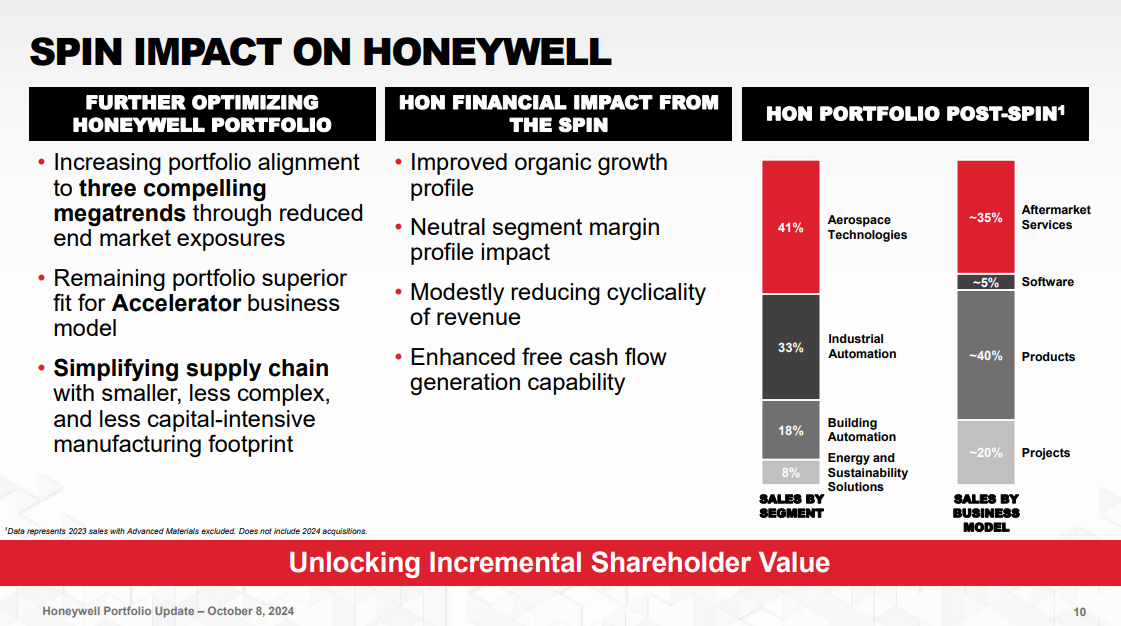
Honeywell published a portfolio update on 8 October 2024. Page 10 showed the company it intended to be after Solstice left: Aerospace 41 per cent, Industrial Automation 33, Building Automation 18, Energy and Sustainability 8. Page 7 committed to bolt-on acquisitions of $1bn to $7bn and to selling whatever didn’t fit.
On 6 February 2025 they announced they were separating Aerospace.
There is nothing in the October deck that hints at it. No asterisk, no strategic-review language, no carefully hedged sentence for the lawyers. The whole framing assumes Aerospace stays and anchors the portfolio, and four months later the anchor was in a box with a Nasdaq ticker on it.
I haven't been able to establish what changed…
What I can establish is what it achieved financially, and that part is not ambiguous at all.
5. What went out the door
HONA issued $16.0bn of senior unsecured notes on 16 March 2026, nine tranches, weighted average coupon 4.95 per cent, only $500m of it floating. Then the money and some of the paper went to the parent.
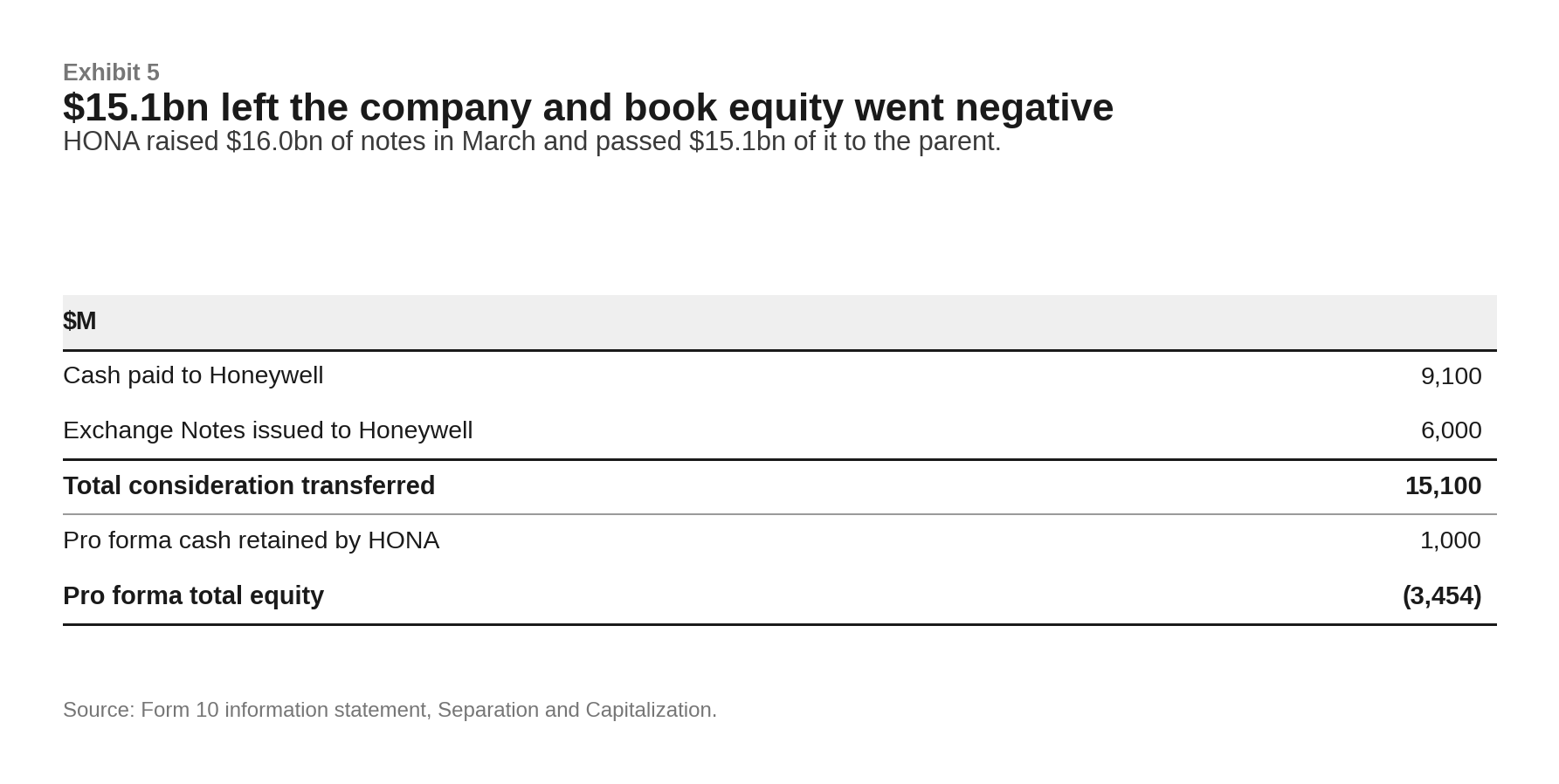
The company started life with negative book equity of $3.5bn, $4.0bn of undrawn revolvers, an intended $4.0bn commercial paper programme and ratings of A3 / BBB+ / A−. It wants to be at 2.5x leverage over the medium term.
Negative three and a half billion of book equity is, to be clear, entirely legal, fairly common after a separation of this kind, and still a strange thing to see on the first balance sheet a company ever files.
For all that, the debt itself isn’t the thing that should worry you. Net debt to 2026 estimated adjusted EBITDA is about 3.0x, and the maturity profile is comfortable to the point of being dull.
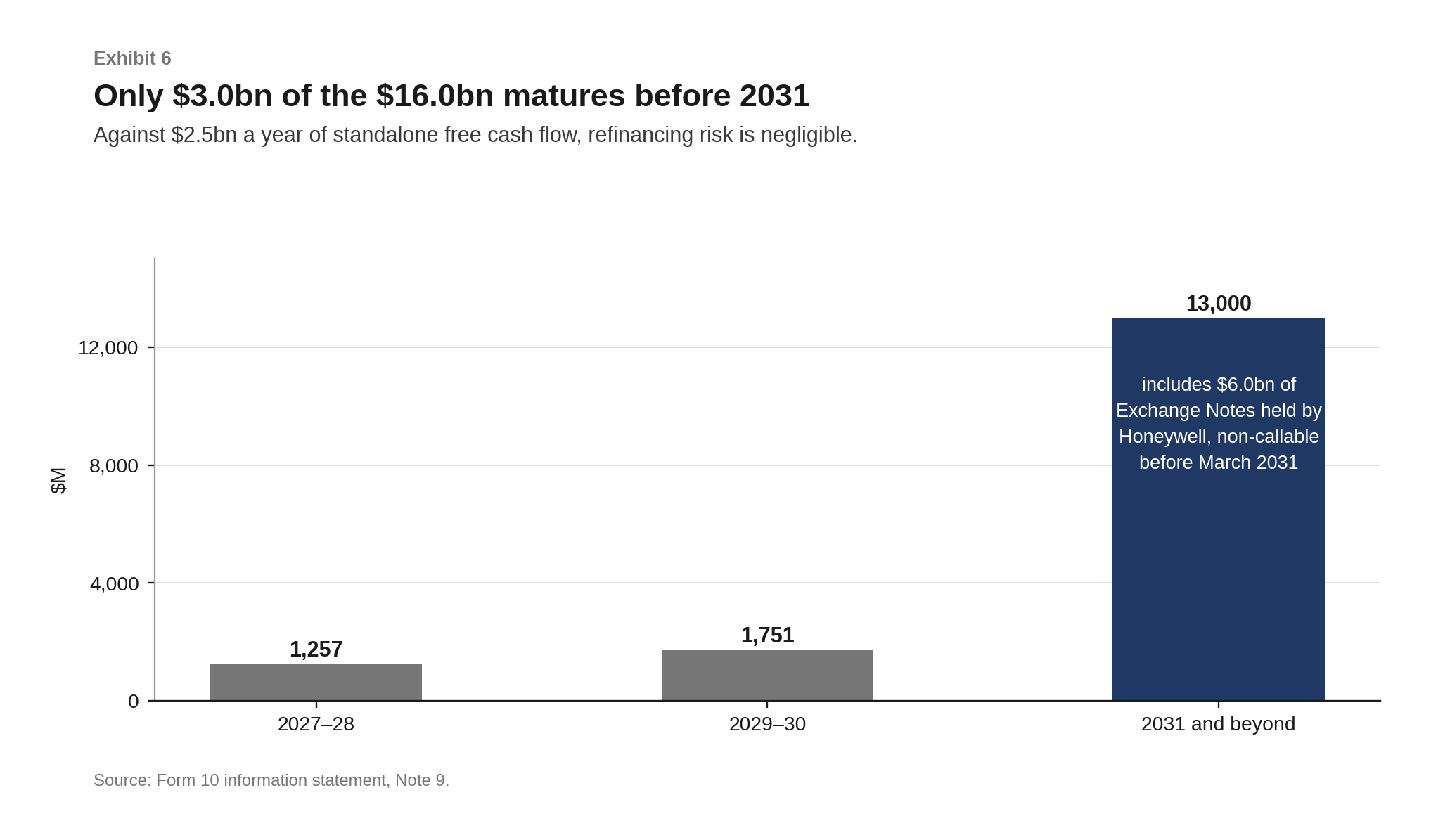
Against $2.5bn a year of pro forma standalone free cash flow there’s no refinancing story here at all through 2030. Whatever eventually kills this thesis, it won’t be the balance sheet.
The way the debt was shaped, on the other hand, is worth twenty minutes of anyone’s time.
6. Honeywell picked the maturities
Six of the sixteen billion went to Honeywell as paper rather than cash, in three tranches: 2046 at 5.622 per cent, 2056 at 5.732, 2066 at 5.852. None of them can be redeemed before 16 March 2031.
Honeywell chose those terms. Twenty, thirty and forty years, at 67 to 90 basis points above what HONA pays on its own new money, with the refinancing door bolted shut for five years. Letting the counterparty pick the tenor and the coupon is a bit like letting your ex choose the restaurant. The food arrives. It is not the restaurant you would have picked.
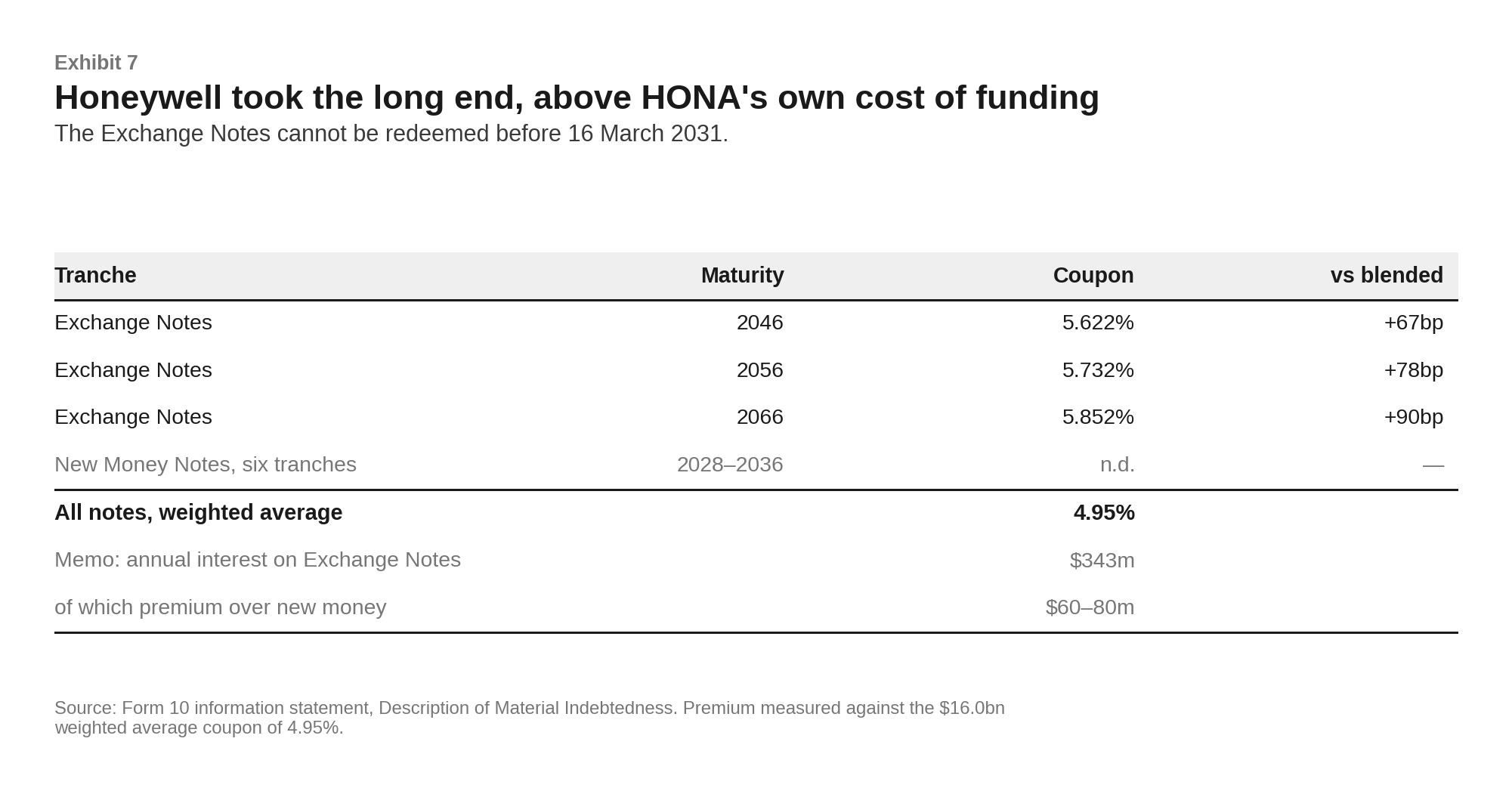
Interest on the Exchange Notes alone runs about $343m a year, of which somewhere between $60m and $80m is the premium over the new money coupons. If rates rally 150 basis points, HONA can’t capture any of it on forty-year duration. My estimate of what that lost flexibility is worth in present value is $1.0bn to $1.5bn, which is an estimate and moves around a lot with the rate path.
Honeywell’s existing bondholders came out of the exchange whole. HONA’s new holders are lending to a 3.0x-levered, negative-equity credit with 327 environmental sites on it. The consideration wasn’t only the size of the cheque. And the cheque, it turns out, was not the last thing HONA agreed to pay for.
7. It pays $1.125bn to use its own name
HONA licenses the Honeywell trademark from Honeywell Technologies for $225m a year, $18.75m within five days of the distribution, then fifty-nine monthly payments of $18.75m, $1.125bn in total.
Read that again slowly. The aerospace business that has carried the Honeywell name since the Allied merger now rents it, monthly, from the company that kept the letterhead.
The price isn’t the interesting part. The exits are lopsided: Honeywell can walk away at year six by reimbursing $250m of the roughly $1.125bn it has been paid, keeping $875m and getting the brand back. If HONA is the one that declines to renew, it gets $50m. Somebody negotiated that clause and somebody else signed it, and the second somebody now runs a public company.
And the licence can be terminated if there’s a change of control Honeywell hasn’t consented to in advance. The Form 10 files this under intellectual property risk. In practice it means anyone who wants to buy this company either gets Honeywell’s blessing or buys a business whose name appears on 90 per cent of the flying fleet and on every FAA-certified nameplate, and then has to take it off. Nobody is re-stencilling forty-seven thousand APUs to close a deal.
What happens to the price after 2031 isn’t disclosed anywhere. Depending where it lands that’s $2bn to $3.5bn of enterprise value, and it’s the first exhibit I’d open if the amended registration statement ever produces it.
8. Three hundred and twenty-seven sites
HONA will own around 120 facilities. It is accruing for environmental remediation at roughly 327 sites. Two hundred and seven more sites than facilities. That gap takes decades of diligent industrial activity to build, and somebody has to own it.
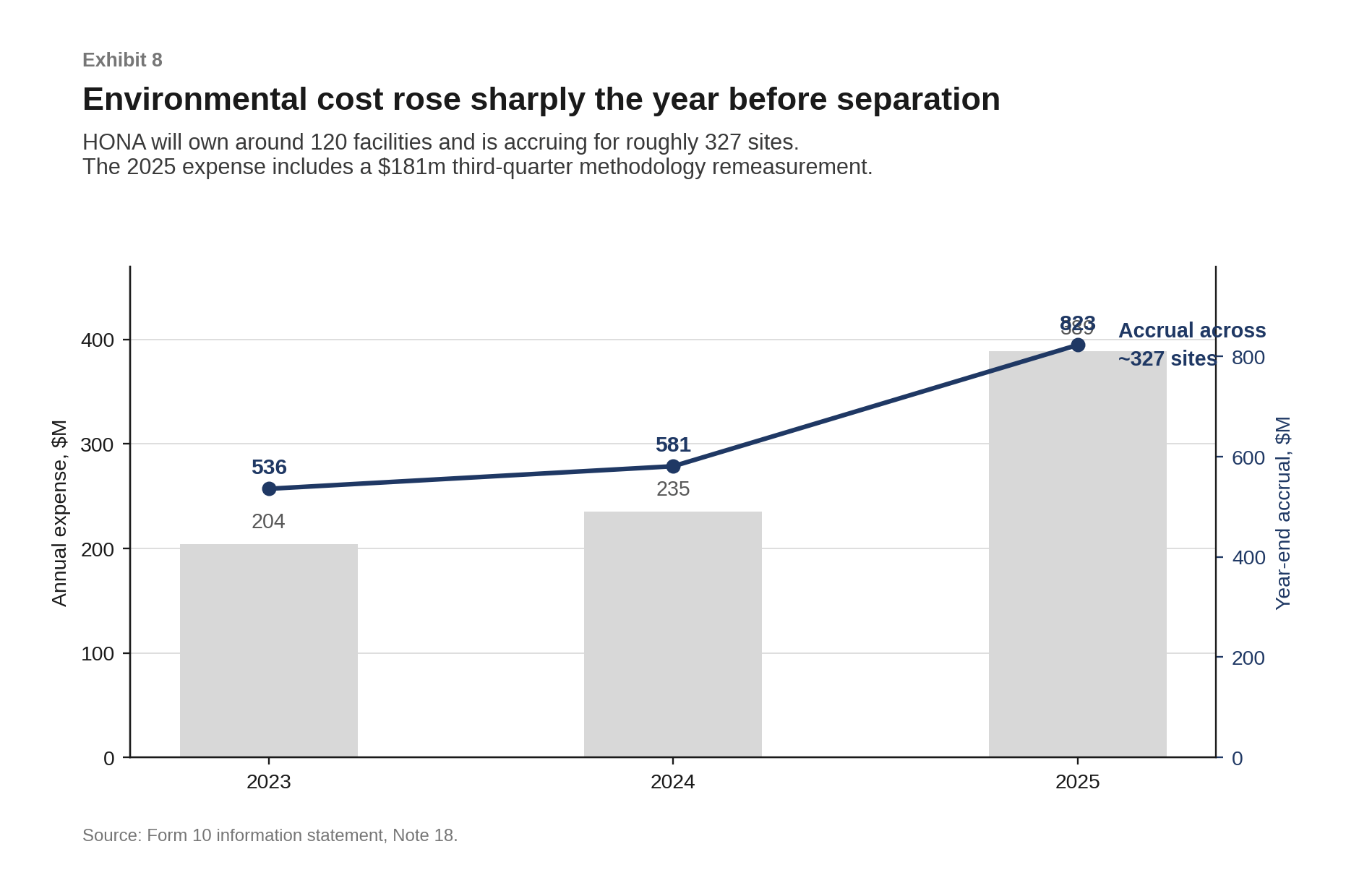
The separation agreement gives HONA every environmental liability except those relating to the Automation business “as currently conducted”, plus certain legacy Automation sites, again "as currently conducted". Four words, appearing twice, doing more work than most people's entire annual review. The qualifier carves forward for Automation and leave the old Allied and AlliedSignal tail, which in most of those places predates the aerospace business entirely, on HONA’s books.
The bit I’d want explained is the timing of the $181m remeasurement. It falls in a carve-out period that every subsequent non-GAAP presentation excludes. You raise the reserve before the separation, take the expense where it has already been agreed nobody will count it, and hand over a balance sheet you can call fully reserved. The Form 10 declines to estimate a reasonably possible loss above the accrual, so there’s no disclosed ceiling on any of it.
9. What the business actually earns
Four different FY2025 revenue figures float around the documents: $17,404m on a GAAP basis, $17,716m Form 10 adjusted, $17,510m as the Honeywell Aero Technologies segment, $17,822m Technologies adjusted. Recent press has added $17.2bn trailing twelve months. Five numbers. One year. One company. I’ve used GAAP throughout, on the grounds that somebody has to.
On profit the company’s own bridge is clean, and more conservative than it needed to be.
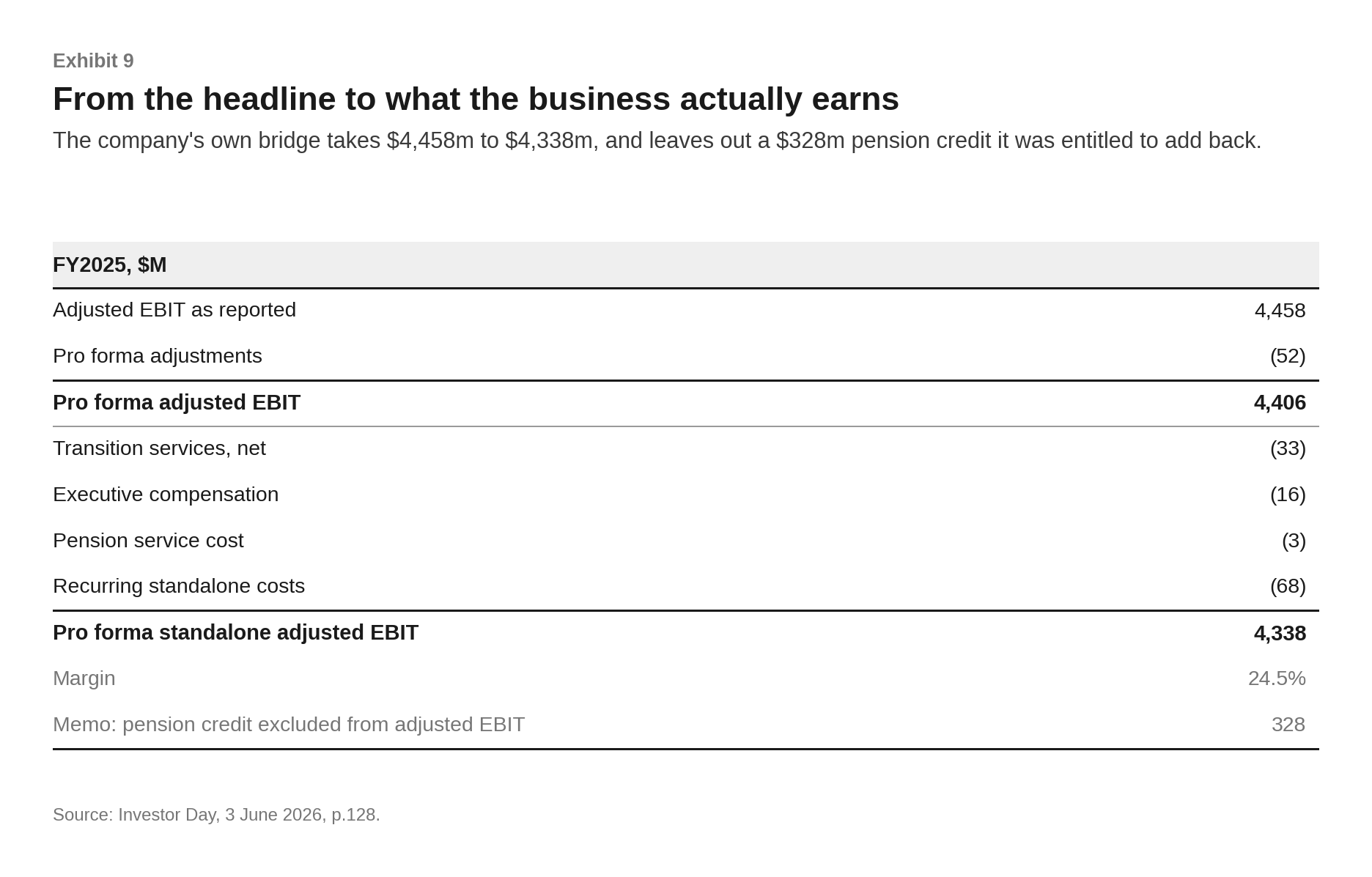
Credit where it’s due. HONA came out of the separation with a net pension asset of $2,727m, which throws off a non-cash P&L credit of about $328m a year. They could have put that in adjusted EBIT and added 7.6 per cent to the headline, and nobody would have stopped them. They left it out. In a document where every incentive pointed the other way, that is an unfashionable decision and it deserves saying.
The $68m of recurring standalone cost is a different matter. That’s 0.4 per cent of sales, and it’s meant to cover external reporting, internal audit, treasury, investor relations, a board, stock administration, and expanding IT, finance, supply chain, HR, legal, tax, facilities, branding, security, government relations and insurance, at a $17.4bn company operating across twenty countries. Sixty-eight million dollars covers a good D&O policy and a mid-sized ERP migration, and then you are out of money. I don’t believe it, and neither, on the evidence, does the company: the first-quarter figure came in at $27m, which annualises to $108m, 59 per cent above the number in the registration statement. The estimate went up before the company existed.
Then there’s the cost that lives permanently below the adjusted line and is nonetheless real money going out.
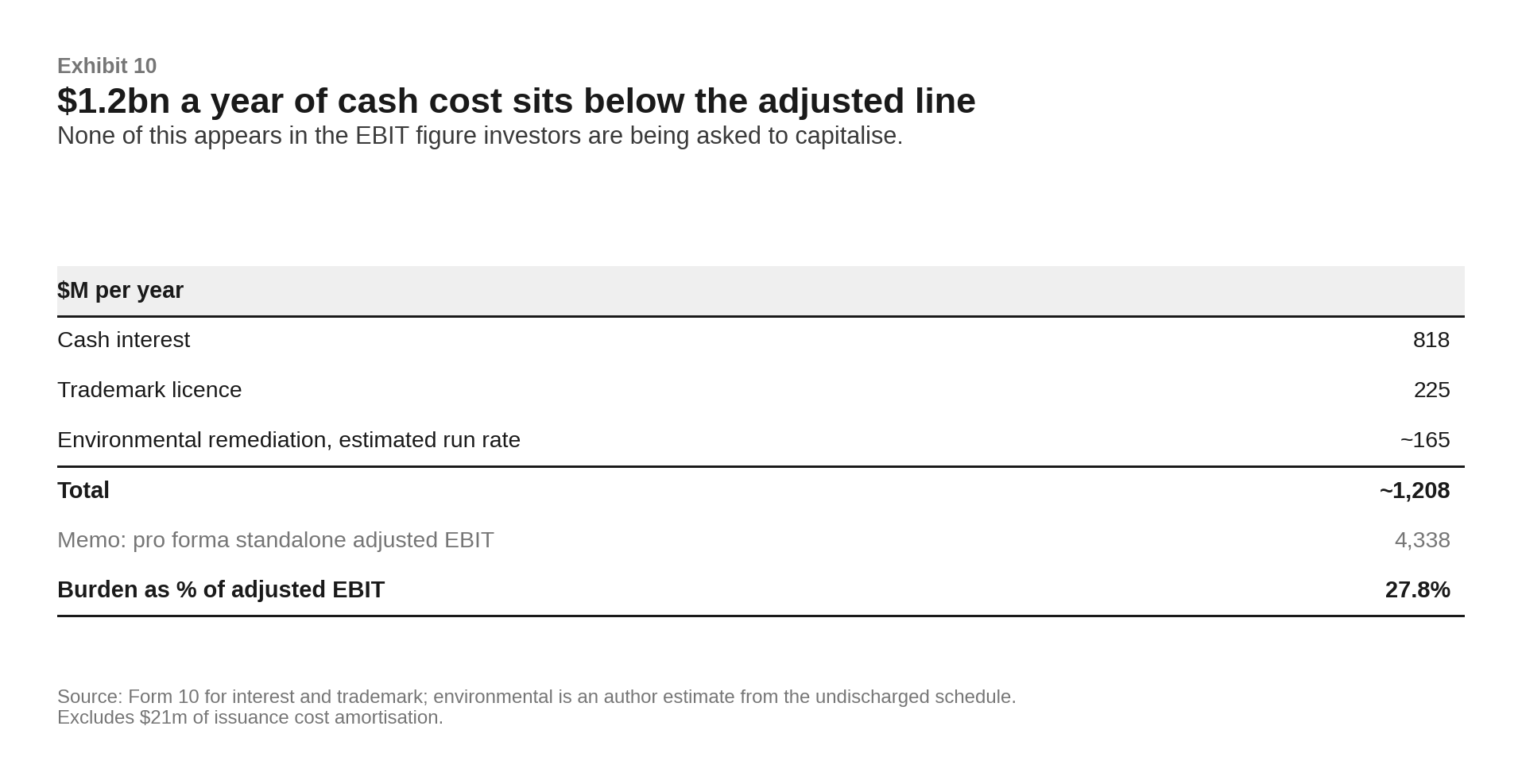
Against $4,338m of pro forma standalone adjusted EBIT, about $1.2bn a year of genuine recurring cash cost sits underneath the number investors are being asked to put a multiple on.
10. The margin stopped responding to volume
This is on page 10 of the investor day deck, without any values on the axis. A chart with no numbers on it isn't a chart, it's a mood.
From 2010 to 2019 Honeywell Aerospace grew sales at roughly 4 per cent a year and took margin from 17.5 per cent to 25.5. Eight hundred basis points on almost no volume.
From 2020 to 2025 it grew sales at roughly 9 per cent a year and took margin from 25.2 per cent to 26.1. Ninety basis points, on revenue up 51 per cent.
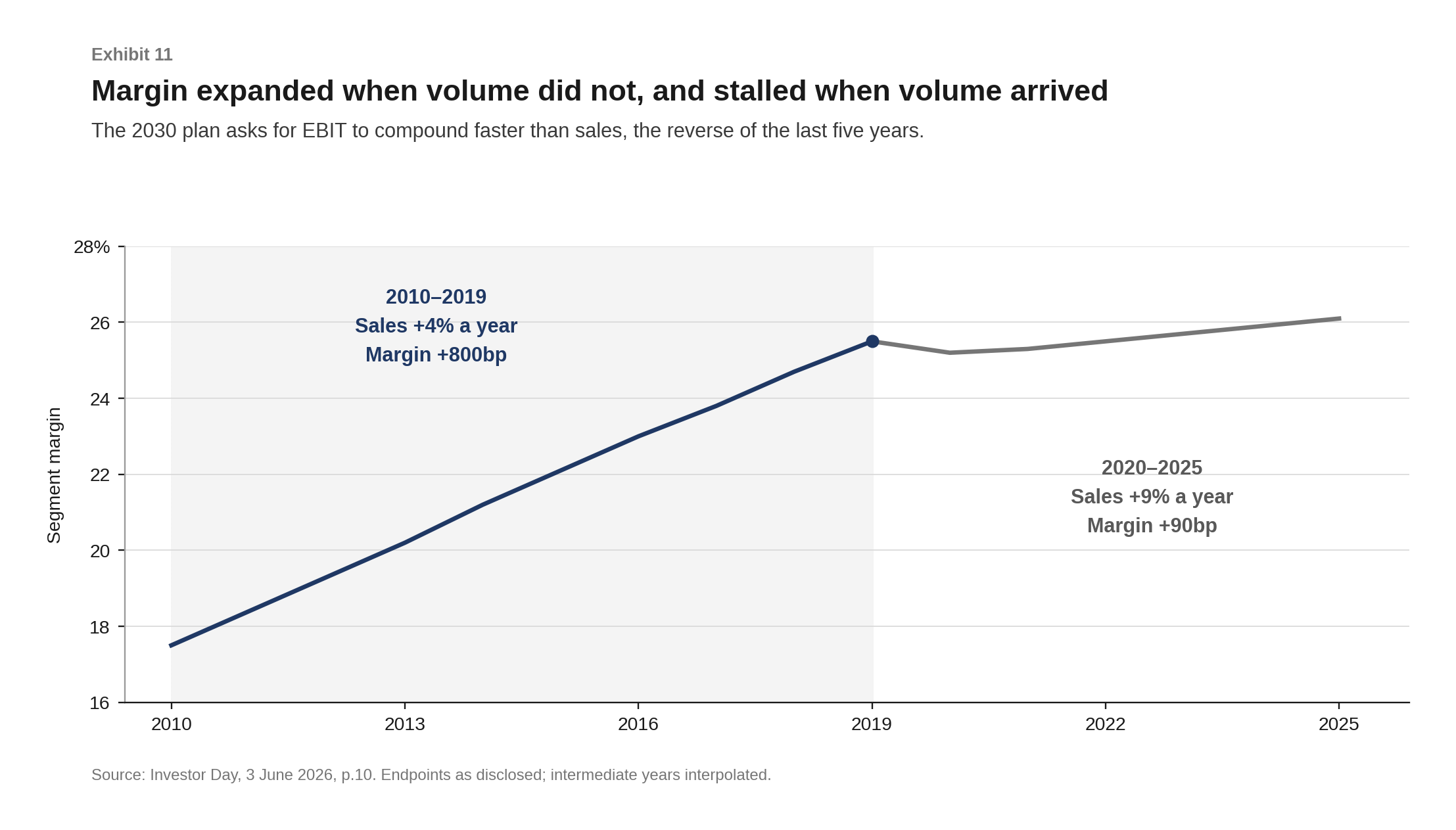
The 2030 plan wants adjusted EBIT above $6.5bn on organic growth of 6 to 8 per cent, so EBIT compounding at around 9 against sales at 6 to 8. It needs operating leverage that the last five years, under essentially the same people, did not deliver.
There is a decent defence of that. The 2020-25 window contains a pandemic, a supply-chain crisis and a 51 per cent volume ramp, and holding 26 per cent margins through all of it might be margin defended rather than margin wasted. I’d accept about half of it.
The trouble is the two halves don’t sit together. If supply-chain disruption explains why margin went nowhere from 2020, then supply-chain disruption is also the explanation for the current guidance cut, and the constraint has been the binding limit on this business for six years rather than two quarters. That is a much longer clock than the one being sold.
A few other things happened to the cost base while nobody was looking.
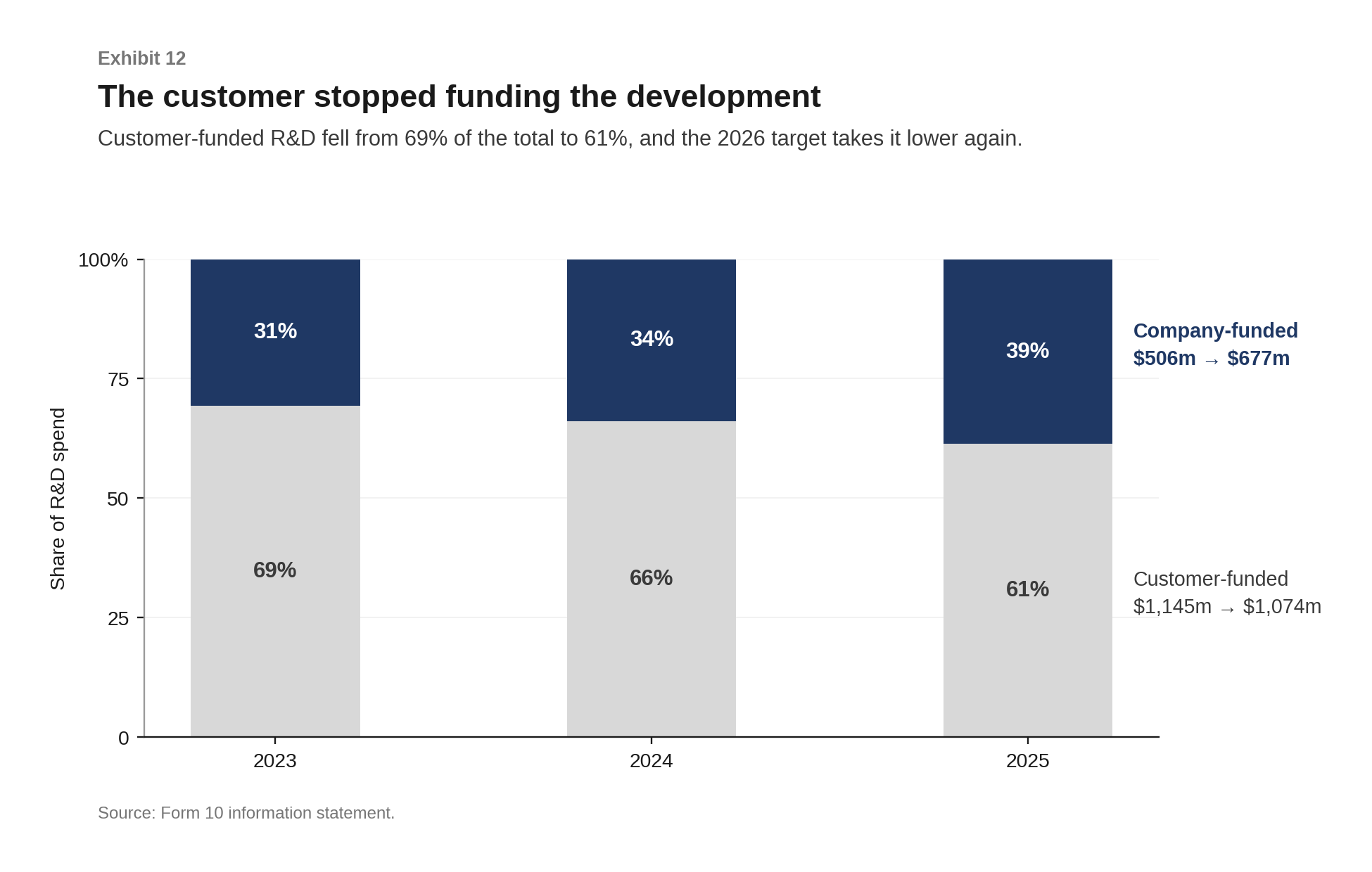
Customers stopped paying for the development. Customer-funded R&D went from $1,145m to $1,074m over three years while company-funded went from $506m to $677m, so the mix moved from 69 per cent customer-funded to 61, and the 2026 target takes it lower again.
Sitting alongside that is $1,185m of capitalised non-recurring engineering in other assets, amortised against units sold over as much as ten years, plus $276m of customer-related intangibles amortising as contra-revenue over fifteen. Call it $1.46bn of capitalised development and customer payments that only converts if the platforms ship at the rates in the model. Which is a graceful way of saying there is one and a half billion dollars on the balance sheet whose entire existence depends on a spreadsheet being right about 2032.
Inventory turns haven’t moved. Flat at about 2.7x for three years running while inventory went from $3,889m to $4,443m. The investor day puts a return to 2018 turns at roughly $1bn of cash and builds it into the 2030 bridge. Nothing in the last three years suggests it’s coming, but it is in the bridge, sitting there, being worth a billion dollars in a PowerPoint.ca
And Engines and Power Systems has now taken two nearly identical charges in consecutive years: $372m of contra-revenue in 2024 for Bombardier, $373m in 2025 for Flexjet. Different customers, same mechanism, which is that Honeywell couldn’t deliver on time and paid them for it. Both excluded from adjusted EBIT. The investor day presents the Bombardier arrangement as a landmark agreement worth around $17bn and doesn’t mention that it cost $372m of revenue. Neither statement is false. One of them is missing a price tag.
Two of those in a row, in the segment most exposed to the castings constraint, aren’t accidents. They’re what the constraint costs, turning up in the one place the adjusted numbers don’t have to carry it. Do it a third year running and it stops being a charge and starts being a business model.
11. Cash conversion, up close
The headline is good. FY2025 operating cash flow of $3,705m against net income of $2,722m is 136 per cent. Pro forma standalone, $2.5bn of free cash flow on $1.78bn of pro forma net income is 140. This isn’t a company massaging accruals.
The first quarter of 2026 is less flattering.
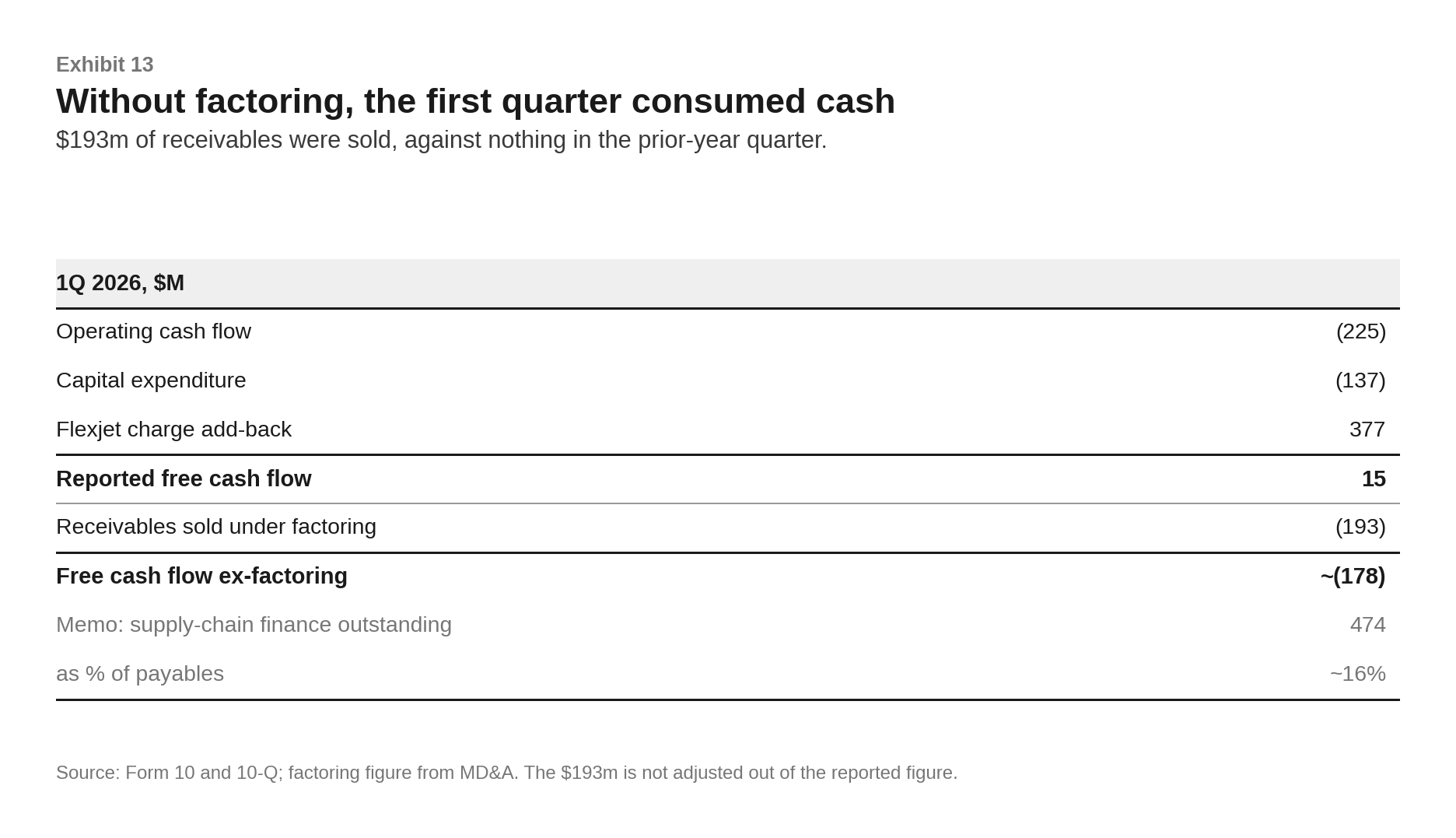
They sold $193m of receivables in the quarter against nothing in the comparable quarter a year earlier, and the MD&A itself credits factoring for the favourable working capital swing. Selling receivables is a perfectly normal treasury activity. Discovering it for the first time in the last quarter before you become somebody else's shareholders' problem is a choice with a certain flavour to it. There is also $474m of supply-chain finance outstanding, about 16 per cent of payables, which will reprice now that the obligor is a standalone BBB+ rather than an A-rated Honeywell.
One number from that quarter has still never been explained. Control Systems: sales down 5 per cent, segment profit down 27 per cent, margin from 36 per cent to 27. A $59m fall in revenue took $120m of profit with it, a decremental margin north of 200 per cent.
which is below his own six-times-salary requirement at almost any share price you care to pick.
12. Said versus done
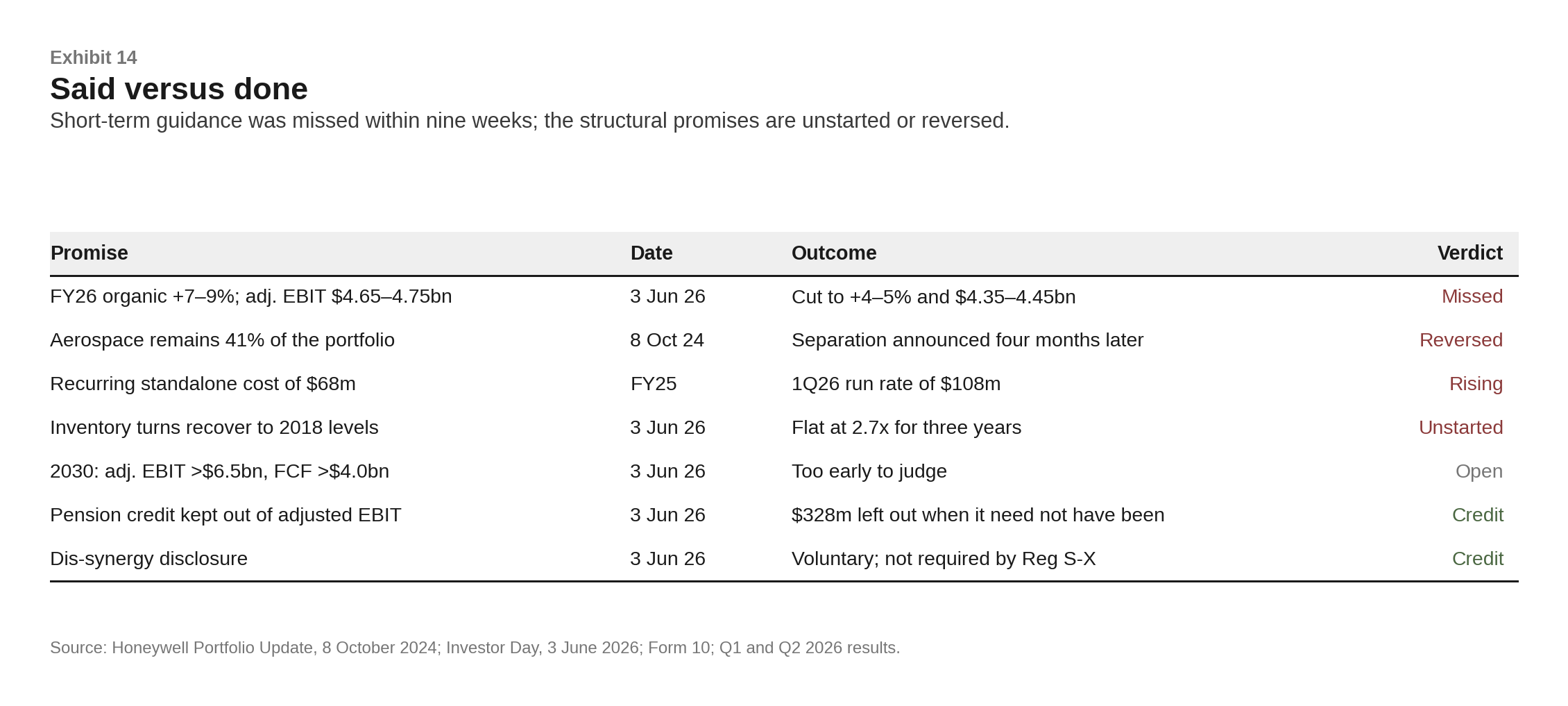
Both entries on the other side belong here too. They kept the $328m pension credit out of adjusted EBIT when nothing obliged them to, and the dis-synergy disclosure is voluntary in the first place, Regulation S-X doesn’t require management adjustments at all, so showing a number and then letting everyone watch it rise was a choice.
Alignment is thinner than I’d like. Directors and officers between them own 151,773 shares, about 0.05 per cent of the company. Currier holds 38,931, which is below his own six-times-salary requirement at almost any share price you care to pick. He is below a rule he helped write. The ownership guidelines were set below the parent’s: six times for the chief executive where Honeywell asked ten, four times for officers where Honeywell asked five. Performance share units convert to time-vesting restricted stock at target, and only the 2025-27 tranche carries a relative shareholder return modifier, benchmarked against an industrials ETF, which is a gentle comparator for an aerospace pure-play in an upcycle.
The board has a specific hole in it. Two sitting mega-cap CFOs, a former Air Force Chief of Staff, a former Air Force acquisition executive, good people for defence business development and for audit credibility. Nobody with operating experience at a tier-one aerospace supplier, at a company whose stated number one problem is getting parts through a factory. The CFO came from Deere less than a year ago and the chief supply chain officer came from automotive in 2025.
Plaintiff firms started soliciting investors for a securities investigation in August. That happens after almost every 20 per cent single-day drop and usually goes nowhere, but given the sixty-three days it belongs in the risk section rather than being ignored.
13. Nobody can buy this company
The most durable finding in the academic work on spin-offs, going back to Cusatis, Miles and Woolridge in 1993, isn’t the excess return. It’s that separating makes both halves more likely to be acquired, and that optionality is part of what spin-off investors are paying for.
Here it has been removed on purpose.
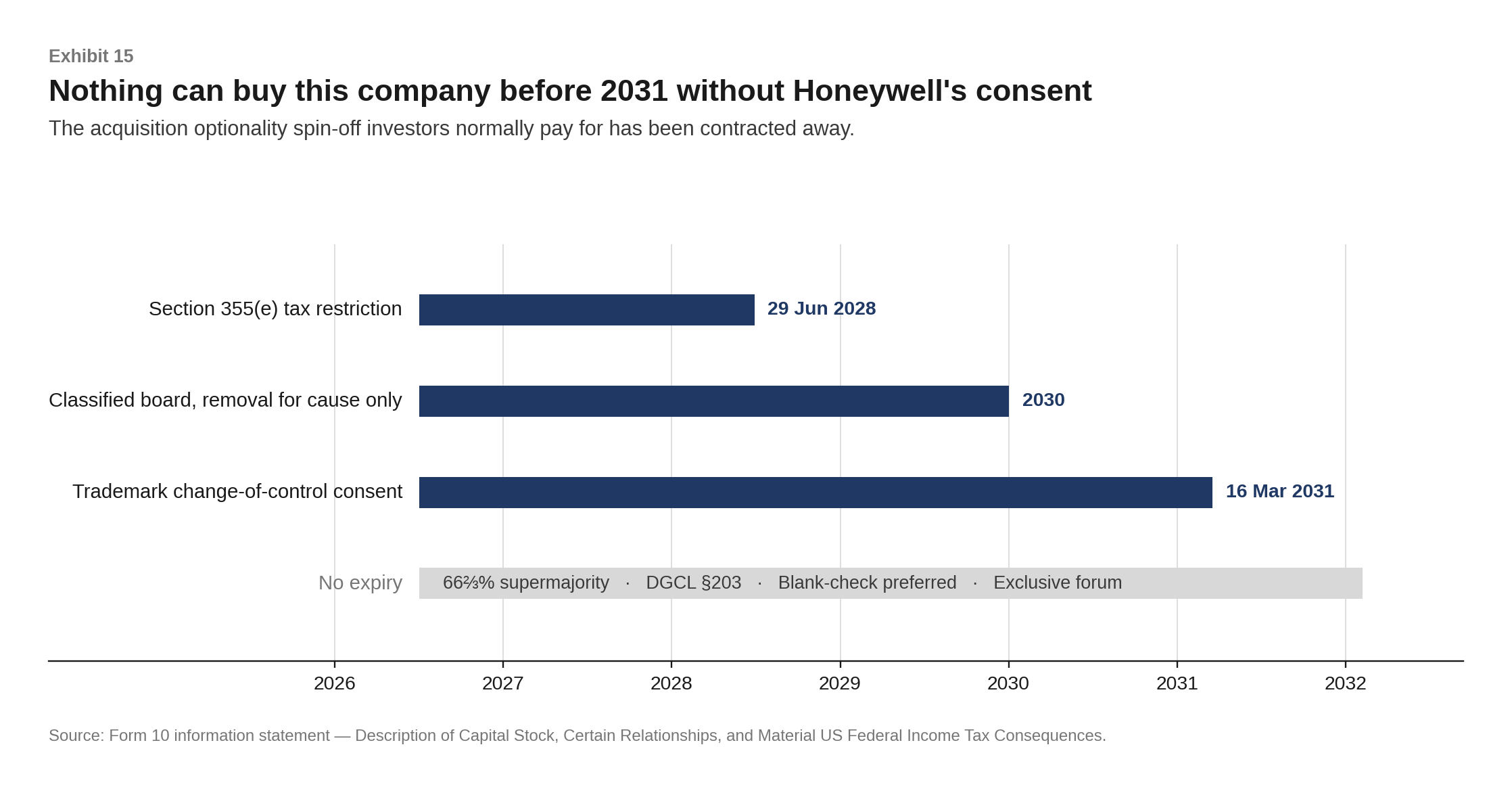
Put them together and HONA can’t change hands before roughly 2031 without Honeywell agreeing to it. Any valuation carrying a takeout premium is carrying something that was contracted away.
There’s a knock-on effect that gets less attention. No activist can force anything either, because the board is classified to 2030 and directors can only be removed for cause. Whatever happens to this company over the next four years, this management team is the one doing it.
Everything below this line is free today.
From 10 October it won’t be. The half you are about to read, the discount decomposed, the three scenarios, the entry price and the target, is the half that goes behind the wall.
Subscribe before 9 October and you keep 40% off for as long as you stay. $21 a month or $210 a year, permanently, instead of $35 and $350. First fifty only.
14. Taking the discount apart
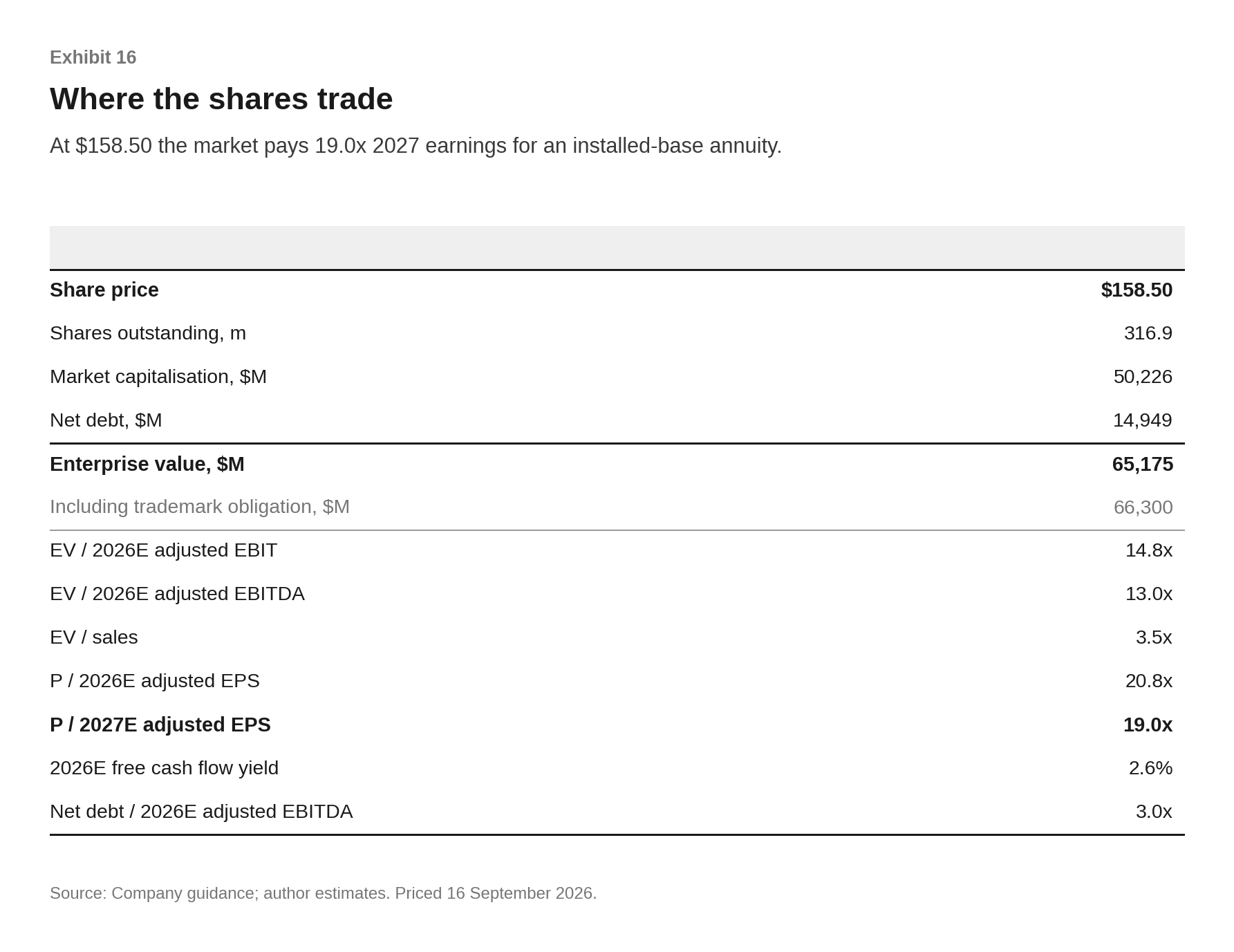
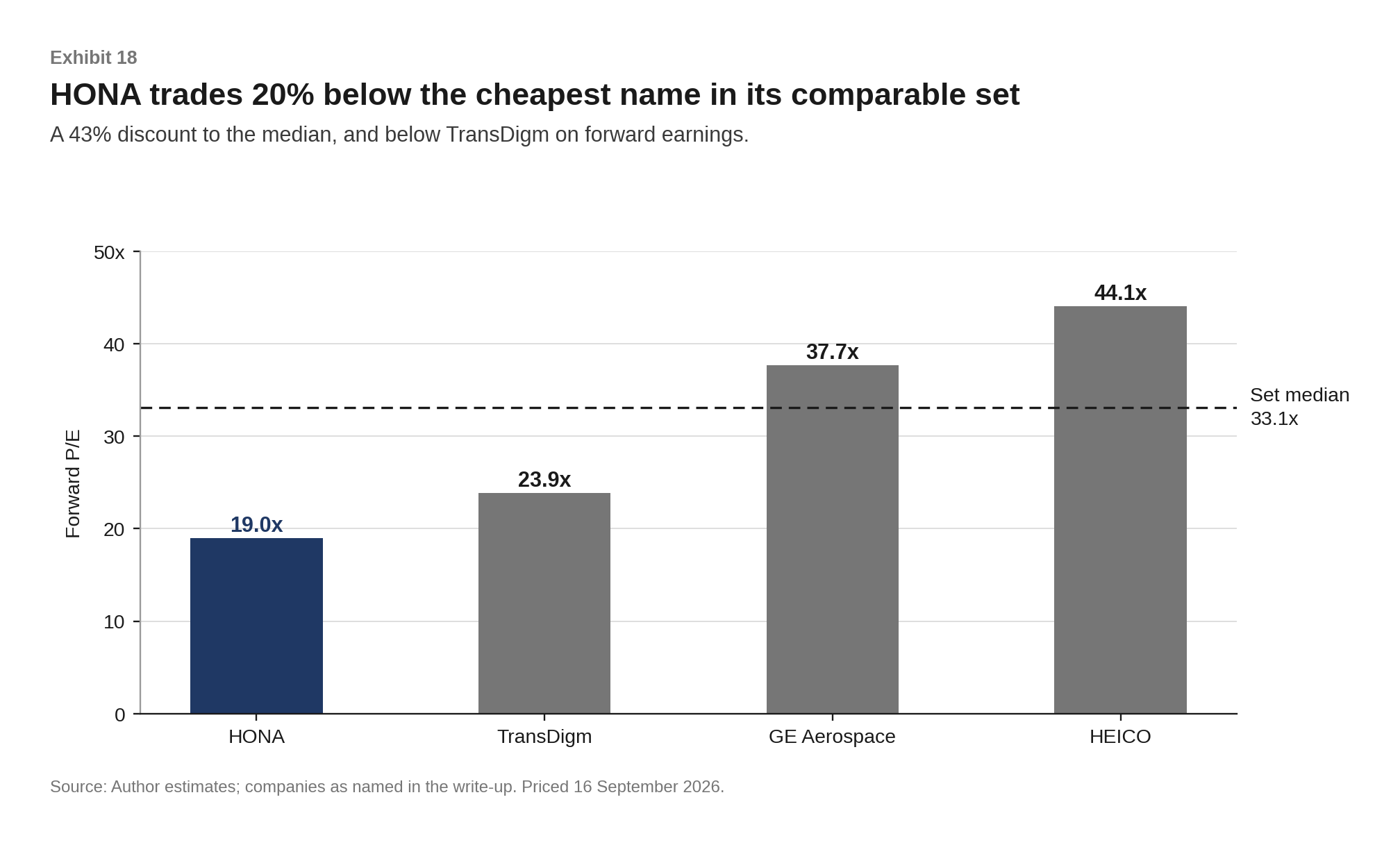
The comparable set trades at a median 33.1x forward earnings. HONA at 19.0x is 43 per cent below that, and 20 per cent below the cheapest name in the group, TransDigm at 23.9x. GE Aerospace is on 37.7x and HEICO on 44.1x.
So the discount is obvious. The question is how much of it the company has earned.
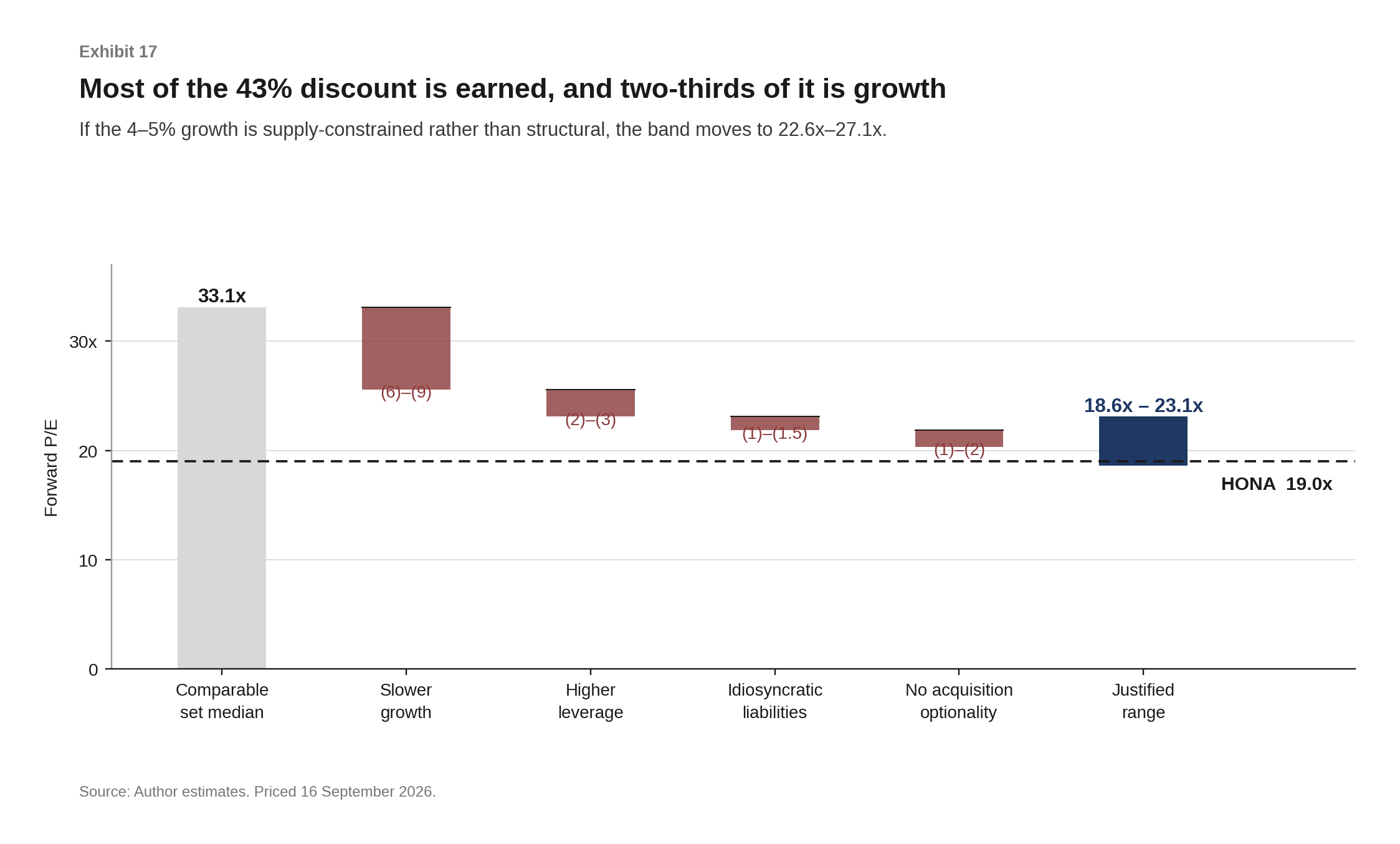
On what the company has disclosed today, 19.0x sits inside that band, near the bottom of it. Most of the discount is deserved. It is not the answer that sells subscriptions, but it is where the arithmetic lands.
But look at the shape of the bridge. Growth is about two-thirds of the whole thing. And if the 4 to 5 per cent turns out to be a supply constraint rather than the underlying rate of the business, the growth penalty is 3 to 5 turns instead of 6 to 9, the justified band becomes 22.6x to 27.1x, and HONA at 19.0x is 16 to 30 per cent too cheap.
That is the entire investment case. The useful thing about it is that somebody resolves it in late October rather than in an argument on the internet.
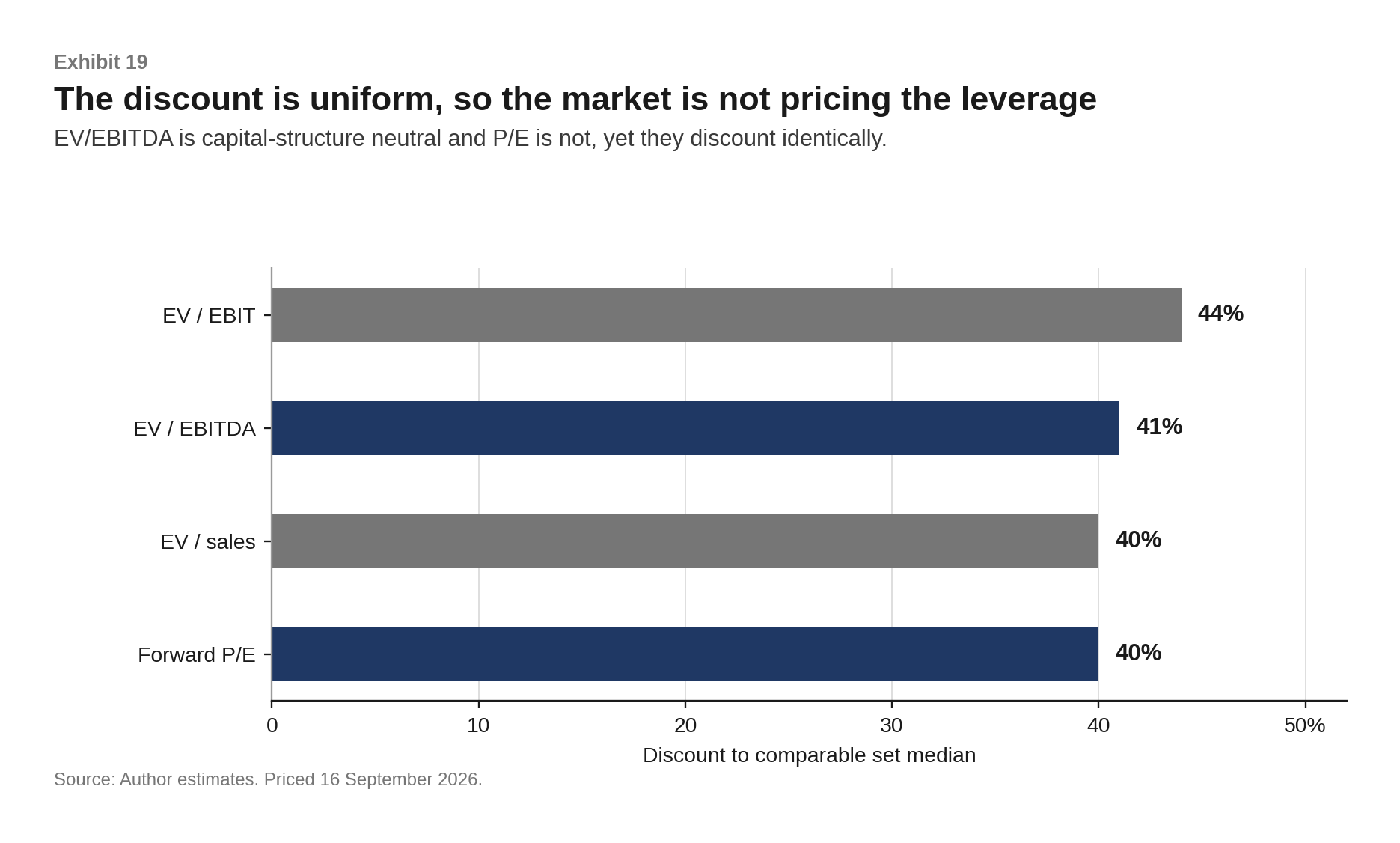
One more observation points the same way. The discount is almost identical on every metric. EV/EBITDA doesn’t care about the capital structure; P/E does. A market really punishing HONA for 3.0x leverage would mark the equity multiple down harder than the enterprise multiple, and it hasn’t, which suggests the leverage penalty isn’t in the price and takes 2 to 3 turns out of the bridge above. I hold that one loosely because it leans on adjusted rather than screened GAAP figures, but it cuts in favour of the shares.
Which brings us back to the thing the company wouldn’t disclose in section 1, the margin differential between aftermarket and OE. If they published it, every number in this section would tighten by half. They haven’t, so it doesn’t.
15. Scenarios and target
I’ve anchored the exit multiples to today’s 19.0x rather than to the peer group, because anchoring to peers quietly builds a re-rating into the base case and calls it an assumption. The bear case de-rates further, on the grounds that a company printing 3 per cent growth on 24 per cent margins through 2028 won’t keep a 19x multiple, the earnings and the multiple move together in that world.
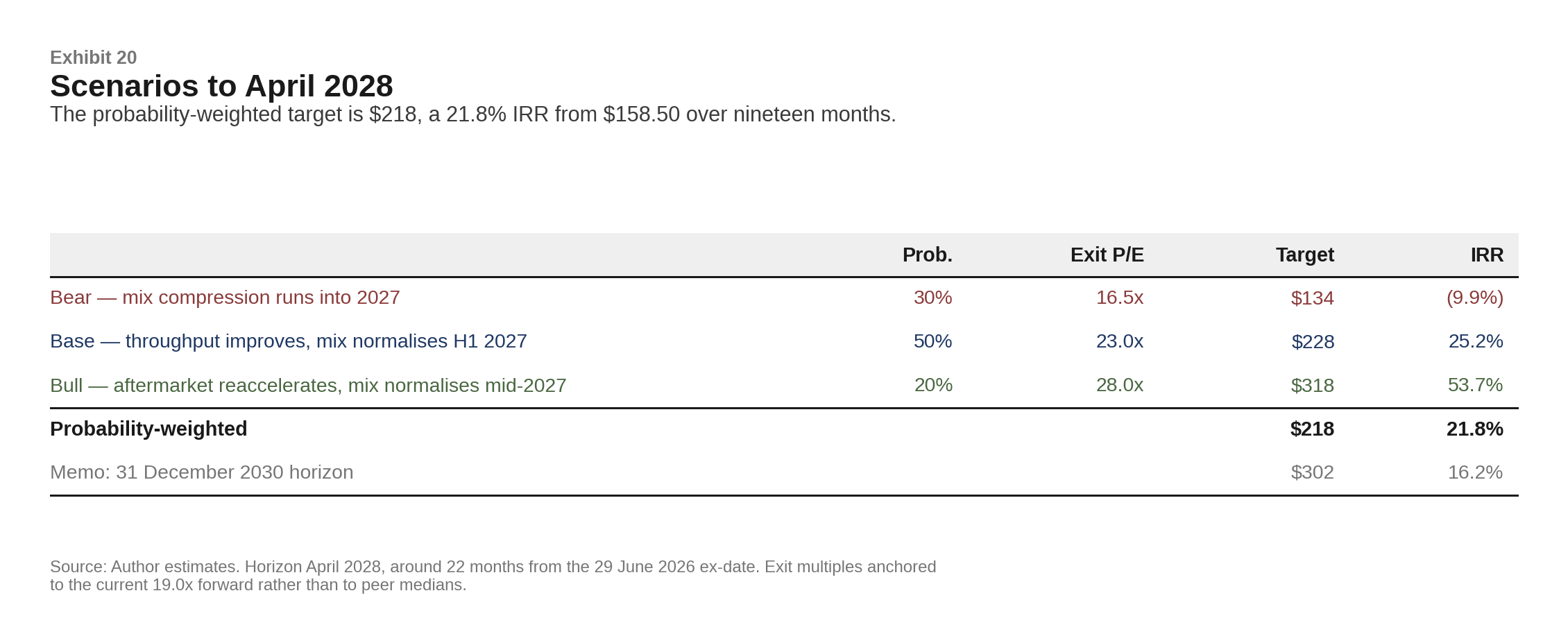
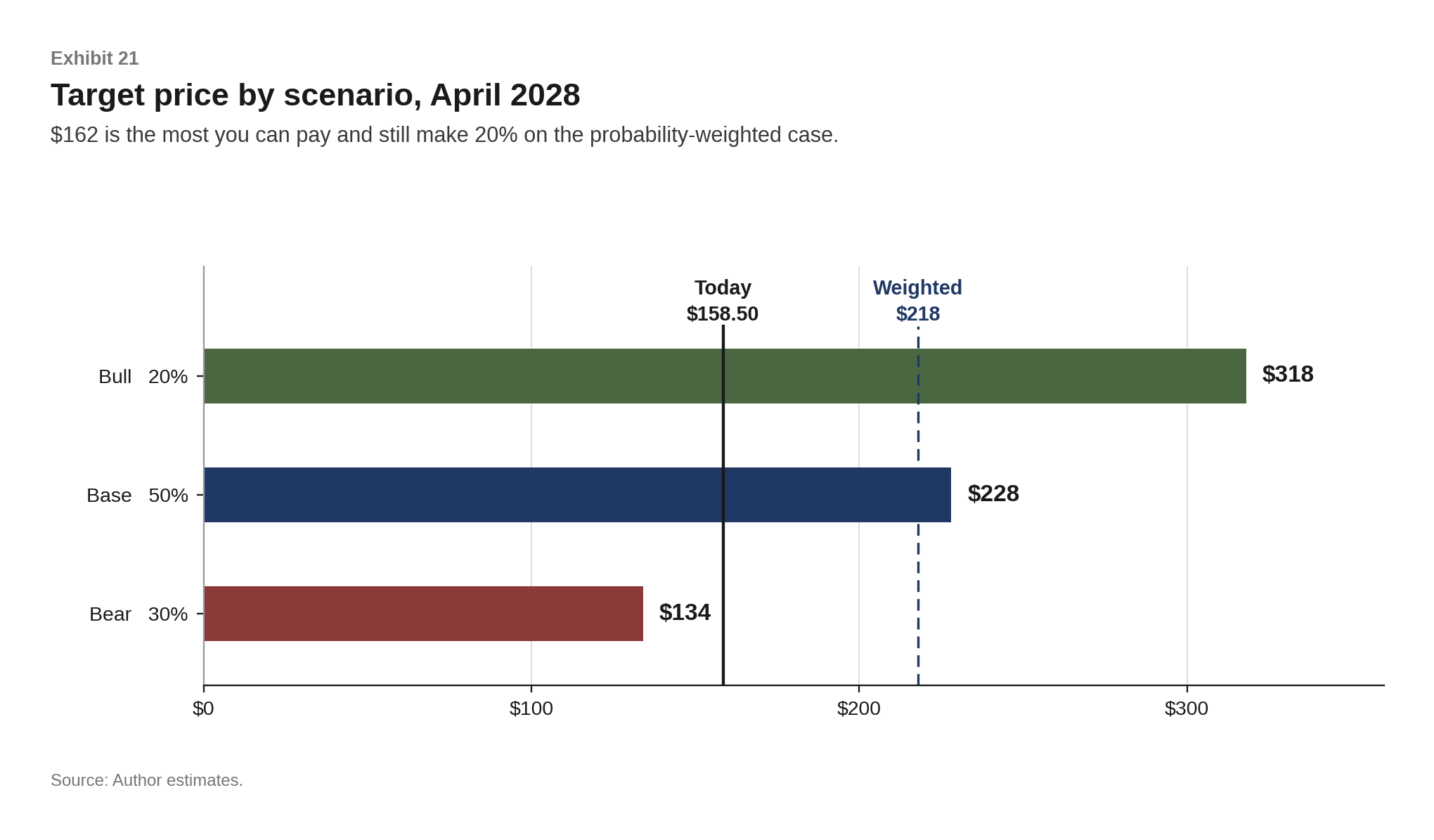
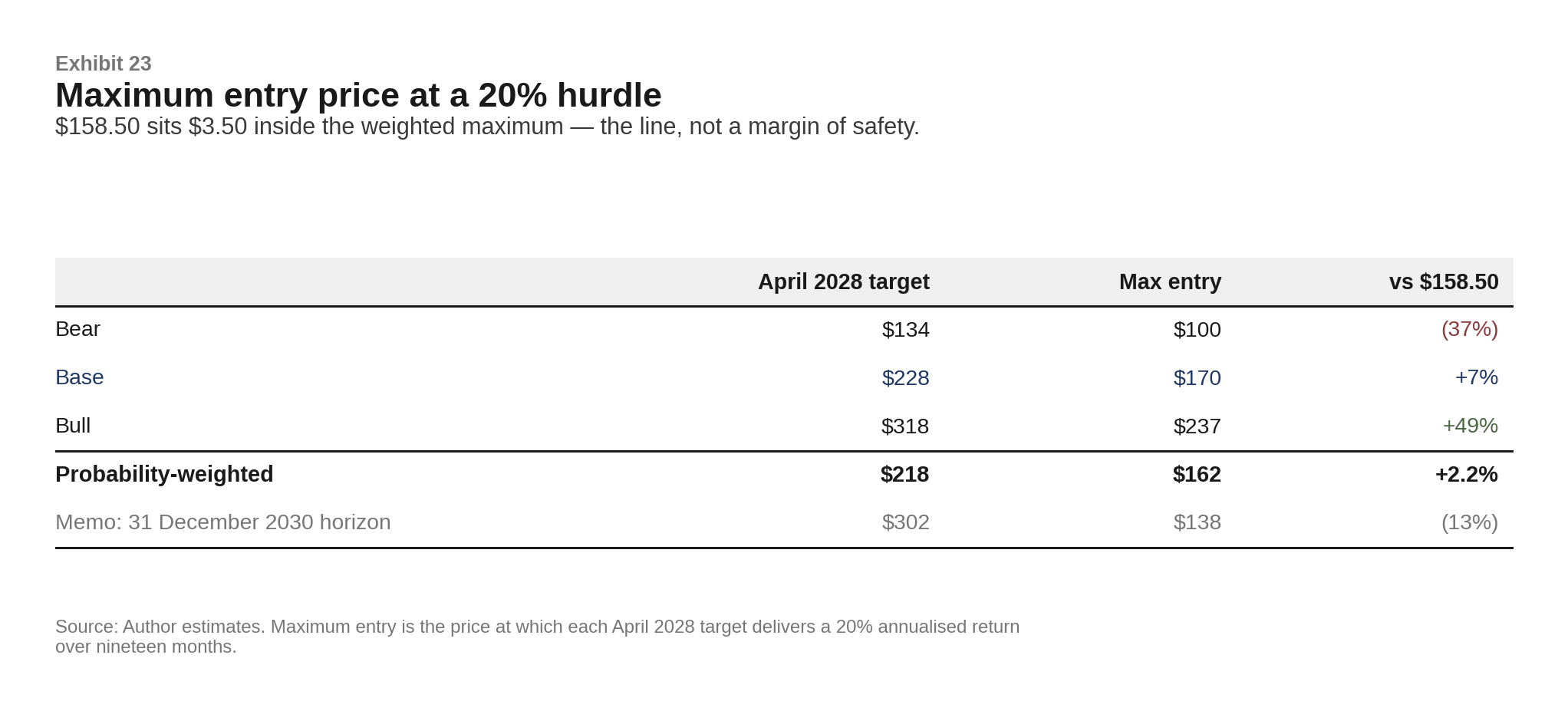
At $158.50 you are $3.50 inside the maximum you can pay and still make 20 per cent on the weighted case. That’s 2.2 per cent of room, which is the line rather than a margin of safety. Three dollars fifty is a rounding error, a bad Tuesday, or the spread on a large order.
What has changed in the last six weeks isn’t the target. It’s what the base case has to do. At $164 you needed an April 2028 exit of $215, which at 23.0x means 2028 EPS of $10.75, essentially the bull case. At $158.50 you need $213, which means EPS of $9.26 against a base case of $9.50. The requirement went from needing the good outcome to needing the ordinary one.
Hold it longer and it stops working. On a 31 December 2030 exit the weighted target is $302 for a 16.2 per cent IRR, with a maximum entry price around $138, thirteen per cent below today. Base-case EPS compounds at 12.2 per cent, which is under the hurdle, so time dilutes whatever advantage the entry price gave you. On a 20 per cent mandate this is a nineteen-month position or it isn’t one.
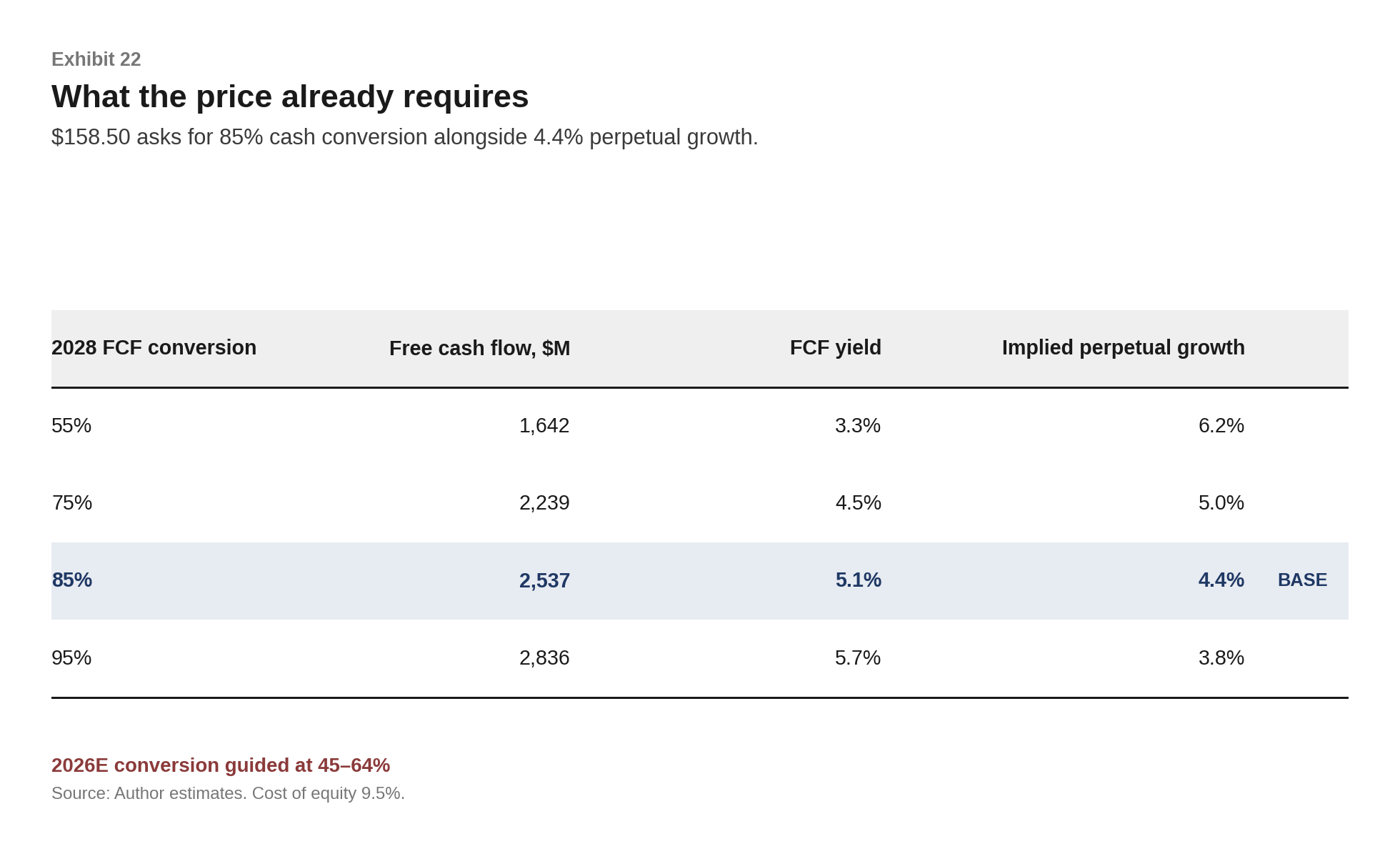
So $158.50 is asking for roughly 85 per cent cash conversion alongside 4.4 per cent perpetual growth, against 45 to 64 per cent conversion guided for this year. No amount of arguing about multiples settles that. It gets settled by whether the inventory releases and the aftermarket mix comes back.
For calibration: Jefferies is at $175 with a Hold, down from $235. Morgan Stanley upgraded to Overweight at $205 on valuation. BMO has an Outperform at $209, down from $276. Consensus is around $224 on twelve months. Everybody's target fell by roughly the amount the share price fell, which is how sell-side targets have always worked and always will. My $218 at April 2028 is below consensus on a longer horizon, which I’d rather say than hide. The differentiated view here isn’t the number, it’s the mechanism, and the date it gets tested.
16. Where I come out
The market has the direction right and is probably overdoing the size of it.
Three things are happening at once and the market is treating the first two as if they were permanent. The guidance cut was real and mostly operational, $250m of the $300m. The bottleneck is real and sits in about sixty suppliers, with fourfold remediation spend already going out. And the aftermarket is being rationed on purpose, which compresses margin for exactly as long as the constraint lasts.
A demand problem and a supply problem look the same in the P&L for two or three quarters and then go in opposite directions for years. Orders up 8 per cent, book-to-bill at 1.1, backlog up 9, commercial aftermarket growing 8 before management throttled it, that isn’t demand.
What I can’t tell you is how long the constraint runs, and that is the whole risk. If it’s still here in 2028 the compounding lost is gone for good: a dollar of reinvestment missed in 2026 can’t be recovered, customers who wait long enough qualify somebody else, and returns on incremental capital don’t come all the way back. The market is right to pay less during a compression window. It’s only wrong if it’s pricing the compression as forever.
At $158.50 the base case pays you 25 per cent a year over nineteen months for taking that view, being wrong costs you 10 per cent a year, and there’s a one-in-five chance of better than 50. I don’t own it. I’d look at it below $162, which is where the weighted case clears 20 per cent, and I’d want a lot more than $3.50 of room before calling it a margin of safety. At $145 the base pays 26 per cent and the weighted case 28, and you stop needing October to go your way.
What kills it:
Third-quarter output growth at 4 per cent or below again with commercial aftermarket organic growth still negative. Then the 4 to 5 per cent is structural, the growth penalty is deserved, and HONA is already inside a justified band of 18.6x to 23.1x.
Backlog falling sequentially for a second consecutive quarter. It already went from $18,566m at 28 March to $18.15bn in Q2. Twice is cancellation, not timing.
Another cut to the 2026 EBIT range. A second one inside six months ends management’s ability to guide to 2030 at all, and the multiple goes with it.
Recurring standalone costs settling above $150m annualised, more than double what the registration statement said.
An environmental accrual increase above $200m in a single quarter, or disclosure of a reasonably possible loss well above the $823m already booked.
Inventory turns still at 2.7x at the end of FY2027, which takes the $1bn release out of the 2030 bridge entirely.
Trademark renewal terms, whenever they appear, pricing meaningfully above $225m a year from 2031.
What confirms it:
Third-quarter output growth above 5 per cent with backlog turning up. That moves the justified band to 22.6x–27.1x and puts today’s price comfortably inside a 20 per cent outcome.
Commercial aftermarket back to high single digit organic growth for two quarters running.
Inventory turns above 3.1x by FY2027, which makes the $1bn bankable.
Currier or Jepsen buying stock in the open market. At 0.05 per cent group ownership it would cost them very little and say a great deal.
Dates:
Late October 2026 Third-quarter results. The first quarter HONA has operated, reported and guided on from beginning to end. This decides it. February 2027 FY2026 close and the first full-year guide. Tells you whether the cut was a one-off or the start of a reset. 29 June 2028 Section 355(e) restriction lapses 16 March 2031 Exchange Notes become callable; trademark licence term ends
Data flags
Numbers in the source material that don’t reconcile. I haven’t adjusted any of them.
Four FY2025 revenue figures circulate: $17,404m GAAP, $17,716m Form 10 adjusted, $17,510m segment, $17,822m Technologies adjusted, plus $17.2bn trailing twelve months in recent press. This piece uses GAAP.
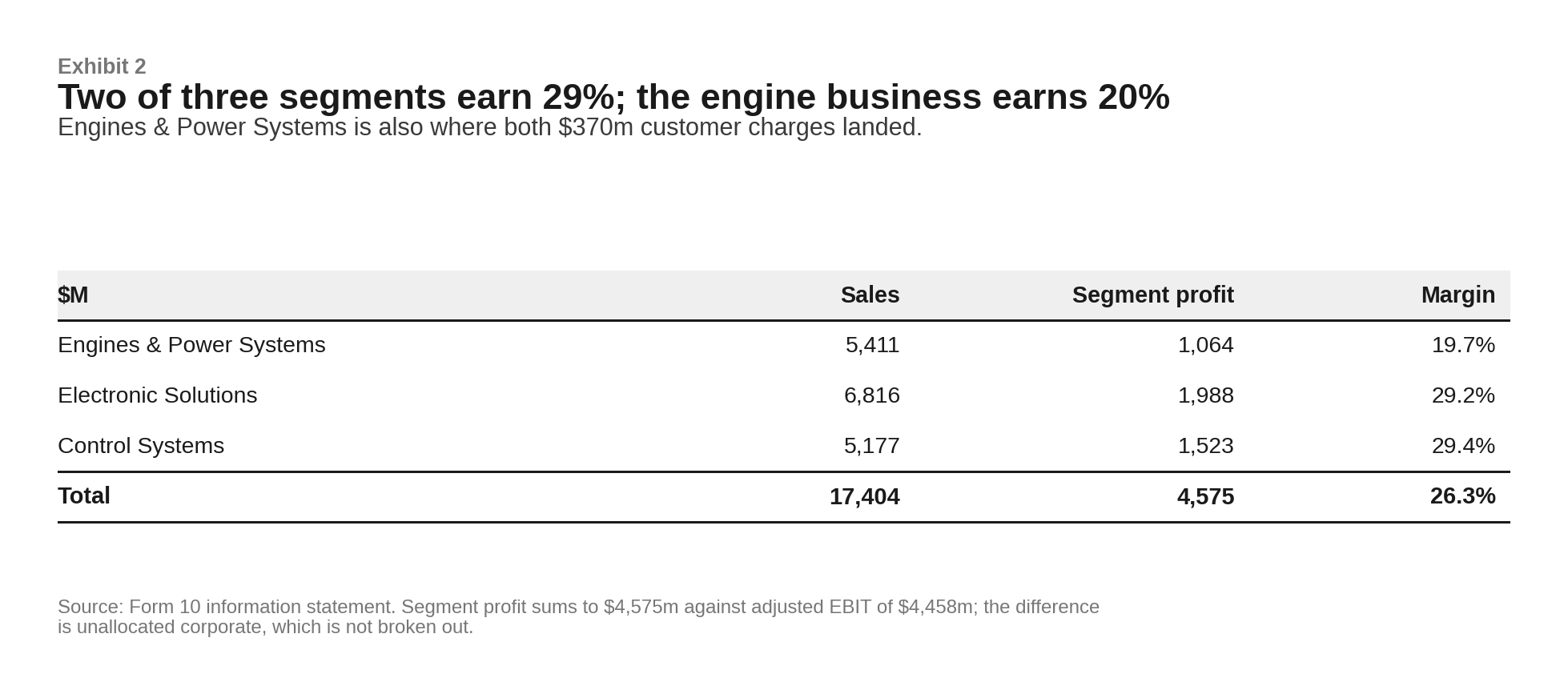
Segment profit sums above adjusted EBIT: $4,575m across the three segments against $4,458m. Presumably unallocated corporate, but the documents don’t say so.
Backlog fell sequentially from $18,566m at 28 March 2026 to $18.15bn in Q2, while being reported as up 9 per cent year on year. Both true; only one is prominent.
The 2030 maximum entry price doesn’t reconcile between the workbook ($144) and the arithmetic from a $302 target at a 31 December 2030 horizon ($138). Worth checking the horizon convention in that cell. Exhibit 23 uses $138.
BlackRock’s 5 per cent holding appears in a June 2026 information statement sourced to a 13G/A filed 29 January 2024, two and a half years earlier.
The Tax Matters Agreement deductible isn’t disclosed. HONA derecognised $262m of unrecognised tax benefit liabilities because the agreement indemnifies above “a specified dollar amount”. That amount appears nowhere.
Method and disclosure
Priced at $158.50 on 16 September 2026. The target is stated at April 2028, around 22 months from the 29 June 2026 ex-date, and is not discounted to present value; the present-value cross-check is Exhibit 22.
Method: standalone economics rebuilt from carve-out and segment disclosure in the Form 10 information statement and the 3 June 2026 investor day; comparable multiples cross-checked against a peer set of aerospace suppliers; three scenarios weighted 30/50/20 with exit multiples anchored to the current 19.0x forward rather than to peer medians. Facts taken from filings are attributed in the exhibit source lines; estimates are identified as estimates in the text.
Confidence: high on the FY2025 audited base and the capital structure; medium on normalised standalone operating cost, where the $68m dis-synergy figure isn’t credible and the real number is unknown; low on anything in 2030, which depends on a supply constraint with no published schedule.
Position: I hold no position in Honeywell Aerospace, Honeywell Technologies, Solstice Advanced Materials, or any comparable named here. I would consider buying below $162, the maximum entry price implied by the probability-weighted case at a 20 per cent hurdle.
None of this is personalised investment advice. Do your own work.
Discussion about this post